Showing posts with label 18th century. Show all posts

Sunday, November 24, 2019

Finished

This house will probably never be "finished" but the installation of the mouldings which the last post was about is now finished, anyway. There were 27 section of moulding, each about 2.4 metres long, it went into the passageway, a stair vestibule and another small vestibule which connects to the end of the main passageway.

Below are a few pictures of the results.

Stair vestibule

A joined corner

Small vestibule
The pattern had to be cut down and joined in the middle in order for the
corners to meet up properly

Another view of the small vestibule

One end

The other end.
The possibility of the corners in both ends lining up was very low and
creative sculpture work had to compensate for the fact that the pattern
did not line up nicely

However, the overall view of it looks fine.

A reminder of what it looked like before this round
And how it looks now (from the opposite end)


Monday, July 9, 2018

A Short History of the Acanthus Leaf

As regular readers will have noted by now, I work a lot in both 18th century rococo style and in medieval styles, (where my true passion lies); some people might find this odd and think there is no connection between the two styles. Having spent a lot of time working with both of them, however, I realise that they actually do have a lot in common.

Over the centuries scores of literary works related to the design, origin, and style of the acanthus have been written and it is not my intention to add anything to what has already been done because I am quite sure I have nothing more to add. I simply want to show the natural evolution and continuity of the form over the course of history.


Detail of a 3rd century BC acanthus and flower base to a Greek column now
on display in the Louvre


Supposedly, the acanthus as an inspiration for ornament, had its origins in 5th century BC Greece. According to legend, as expounded by Vitruvius (1st century BC Roman author and historian) Callimachus (5th century BC Greek architect and sculptor) saw a basket which had an Acanthus Mollis plant growing around it and a tile on top, and this inspired the now famous form of the Corinthian Capital; which, of course, has acanthus leaves as its main ornamental motif. It would seem, however, that the plant soon gave inspiration to the ornamentation of more than just capitals, as can be seen by the column base from the 3rd century BC, pictured above.


Louis XIV ornament from Versailles; this ornament has a direct connection
with the ornament more than two thousand years prior, as pictured above
and was the the last in the evolutionary link leading up to the Rococo stlye


Most art histories will tell you that the forms of Greco-Roman art were "rediscovered" in the 14th century, which gave rise to the Italian, and then European wide Renaissance. (Which evolved into Baroque and the Rocco art, respectively) There are many problems with this notion, however, because the Greek and Roman ruins were scattered all over Europe, only gradually disappearing due to re-use and other ravages of time, never wholly being obliterated. Medieval artists had plenty of Classical inspiration to choose from, when and if they chose. The 1st century Roman "engaged" column, pictured below, is a good example; it was re-used as a door jamb during the Middle Ages. One can find nearly inexhaustible references to this basic motive throughout the medieval period, interpreted by each generation according to their own sense of "modern" taste and inventiveness.


Roman relief of the 1st century AD, now in the MET
12th century
scrolling ornament
Louvre

The above picture, which is from the side of an altar, now in the Louvre, is a direct artistic evolutionary continuation of the Roman example pictured above. Over time, the leaves changed and birds and figures replaced the original flower at the centre of the design, but this is an evolution of the same idea, as seen through the eyes of 11th and 12th century artists. Other variations on the same theme can be seen in the following two illustrations as well.


12th century acanthus capitals from Saint-Guillhem-le-Desert
now in the Cloisters, New York

Detail of a 6th century marble column from
Toulouse, now in the Louvre


Supposedly the Romans added the curled heads to the Greek acanthus leaf, giving us the style that we are most familiar with today. I am not sure how true that statement is, because there is some curling to the design pictured at the beginning of this article. There is also a 4th or 3rd century BC Greek funerary urn that I photographed, which has a somewhat curly form to it as well. (pictured below)


4th or 3rd century BC base of a Greek funerary urn. North Carolina Museum
of Art


The leaf of this urn is very much in keeping with the style of those on the 6th century column, the 9th century ivory plaque, pictured below, and the 12th century capitals, shown above and below. This form of the acanthus had a long and variegated history, but it is almost always recognisable as having the same pedigree. 


Detail of  Carolingian ivory, now in the Cloisters

End of a 12th century compound capital now in the Cloisters


There was another form of the acanthus, however, (with pointed "spiky" leaves) which also had prominent use, but more commonly in the Greek and Byzantine sphere of Europe, than in the western lands. Many examples, both Medieval and Classical, exist, and this form also continued through the Middle Ages and into the Renaissance, as demonstrated by the column segment shown below.


An engaged capital of 9th century Byzantine form, now in the Louvre


An early 16th century renaissance column
now in Philadelphia Museum of Art


It was the curly headed version that was the most common throughout most of Europe, and the form which carried on into the 18th century rococo period.

Crest of a 15th century altarpiece, now in the Cloisters

Detail of a renaissance tapestry, now in the MET

Detail of an acanthus corner on a highly decorated casket, now in Philadelphia


The supposed "unbridled" exuberance of the 18th century French taste had many previous incarnations, as demonstrated by the Roman painting from Pompeii, (2nd illustration, below) the curled and playful leaves of the Romanesque period, and the late Gothic, "flamboyant" style of the 15th and 16th centuries. (3rd and last picture, below)


Part of a Stained glass border; French ca. 1200 Now in Philadelphia


Detail of a wall painting from Pompeii, now in the MET

15th century frieze, carved in wood, now in Philadelphia

18th century acanthus ornament from Chateau Champs-sur-Marne

Late 15th or early 16th century tapestry, now in the Cloisters


In art nothing is ever really new, and everything draws inspiration from what came before. In decoration, there has always been a sense of coming and going of fashion, and ornamentation has a very cyclical nature. Things turn up again and again, and motifs fall in and out of popular favour to a greater or lesser degree, but nothing ever really disappears. The Gothic style "fell out of taste" in the 16th century, but can still be found in some places into the 17th; by the middle of the 18th century it had its first "revival", and has been in and out of fashion ever since. Likewise, the rococo style fell out of favour around the time of the French revolution, but by the 1840's was being produced again in fashionable circles, and in fact, in provincial France, the style never ceased to be appreciated.


(all photos for this article are my own, taken on various museum visits in the past couple of years)


Videre Scire

Sunday, February 18, 2018

A Method To My Madness

When I was in Europe on my Photography trip last summer I had two agendas. The first was to visit museums and see medieval objects which I knew of (and hopefully some that I did not) and the second was to find 18th century pieces which I could use for my work.


Back when I studied "Interior and Product Design" (furniture) at Berkshire
College of Art and Design, this is how I spent all of every day. It has been
a long time since I did this, but it feels good to be doing it again.


For the nearly two months now I have been working up designs from some of the pieces I saw in the Chateaus I visited in France. I begin with the photographs I took and adapt them to the requirements of a client who wants a pieces similar to the original. Some re-working of the design is necessary due to differences in size or in use of the object. (A desk has different dimensions to an occasional table, for example)

Below are some photos of some of my design work and a couple pictures of the inspirational piece.


An urn in Chateau Champse-sur-Marne.
Mine will be about half the size of this one

Designing is a bit different than "drawing". In
design it is not necessary to draw more than what
is needed, but is is necessary to draw the details
as they would be on a pattern, not as they look
in perspective.

Design for a desk, adapted from a table seen in Köln

The actual table


Some details and proportions needed to be changed so that this could be a
functional desk. One could not put a chair under the table and sit at it because
the centre hangs too low. I also made the front to be a drawer.

Detail of the legs

A box from the MET


Drawing and detail shots of another table, also adapted to serve as a desk.
The same challenge applied to this one, as the centre on the original was
 much too low to be used as a desk.


Sunday, June 18, 2017

A Rant against Mediocrity

Anyone who has even been slightly paying attention to my blog posts will have noted by now that I like highly ornamental and decorative designs and do not shy away from the intricate or complex. I once designed something for a client, and when I presented the drawing, got the comment of "that is not going to be easy, is it?"to which I replied, "I do not do 'easy', If it was easy, it would be someone else's job." I enjoy the challenges that complex designs provide, and find making simple things extremely boring and uninteresting.


An early 19th century "Pietre Dure" table in the national Gallery, Washington
Made before people wanted everything "easy" to do
(own photo)


Part of my work involves coordinating tasks with other contractors to do work that I do not have time to do, or is outside of the scope of what I am proficient in accomplishing. In that vein, I was trying to work with three contractors this past week for the tasks of upholstery, painting, and marble work. All three had the same basic paraphrased complaint against what I wanted them to do. "That is too complicated, why can't you come up with a design which is easier?" They did not want to do the work I was asking for because it would take some actual thought and time (which they would be getting paid for) to complete. They would much rather do something simple and straight-forward; get done and get paid. Getting done seems to be the main goal of the modern contractor, with no enjoyment of the process of doing.

This reminded me of my college days studying interior design. At that time I realised why most modern architecture was so boring, In those days everything was still drawn on a draughting table with pencil, pen, triangle and parallel ruler. As a result, everyone wanted to do the simplest design they could get away with. once, we all had one project which involved drawing several walls all in brick, all of my classmates griped and complained endlessly about how long it took to do. Many of them tried to come up with methods to avoid drawing the bricks altogether, such as using a plastic brick template which would imprint the pattern onto the parchment, or drawing a grid instead of a running bond, both with horrible results. Draughting itself is an art which takes skill and practice to perfect, and something which one can take pride in achieving; an art which is completely and sadly lost with the age of computers. (The twisted irony is they now have programs to make the computer renderings "look like" daughtsmanship to give it "character"!)

I often got into conflict with my professors over design style; they wanted me to do "modern" things, and I wanted to do things which had style and elegance, which, to them were usually "outdated" or too complex, There was a sense that any style that had been previously used could not be used again, except that did not really hold true, because simple designs void of any decoration or real creativity had been being invented for most of the 20th century, fueled, in my opinion, by two things; a desire to be different, for the sake of difference, at the cost of beauty, and a general laziness resulting in trying to make things "easier".


A former factory building in Seville, Spain. It was built from day one as a factory
and continued as such until the 1950's
(source, Wikipedia)
A modern factory. Both of these factory buildings were built to process the same
raw material. The first was built in an era when people took pride in what they
built. I wonder if anyone would be interested in the second facade 300 years
from now. This is the sort of design my professors expected me to produce
but the first image is the sort of designing that I wanted to do. Sadly,
our world is now filled to overflowing with the sterile hulks of this style.


Wanting to make things "easier" is nothing new in human history, we have been inventing labour saving devices for thousands of years, and for the most part, these inventions have been useful and helpful. The past hundred years though, have marked a new phase in human invention, which is going from improving the way things get done, to creating devices for the lazy, and encouraging a general lack of skill. I have a poster on my wall with a quotation from Ogden Nash, " Progress may have been all right once, but it has been going on far too long." (He died in 1971, I wonder what he would think of 2017?)

Pick up any woodworking companies' catalog, today, and one will find hundreds of gadget which are designed to be so simple and easy to use, that "anyone" can do a task which formerly required someone with an acquired set of skills to accomplish. It used to be that a carver, for example,  would begin as an apprentice when  his muscles and brain were still so young as to be easily taught. He would then spend his youth honing his skills to be able to achieve the exquisite carvings which are seldom ever seen by even the best carvers of our day. (There is a reason that the best guitar players of our times all began playing when they were kids, it is much more difficult to train the adult mind/hand coordination.) Nowadays, no one seems to even be willing to invest the amount of time in a lot of skills to become proficient at them, and instead try to invent machines and computers to substitute for the time they do not want to spend. This comes partly from a lack of interest in keeping skills alive, partly from valuing income over a pride in accomplishment, and in my opinion, a general laziness inherit in our general human race. Personally, my biggest argument for my belief that God is an human invention is found in the very writings which are supposed to "prove" his existence. In this story, God "spoke" and things appeared, this has a very suspiciously human characteristic to it; a true "creator" would relish and enjoy the act of creating, he would want to "get his hands dirty" and actually be actively involved in making the things he thought of. A lazy human wants to "speak the word" (press a button on a computer) and have things come instantly into being.

A sad byproduct of this 'dumbing down' of creativity and design and of trying to make everything as simple as possible, has been to produce generations of consumers who no longer even know what fine quality, design and creativity look like. They go to the stores and shops and see mass produced rubbish and assume that is the way things should look. As a result, almost no one wants to pay for anything to be made well. I once spent eight hours hand rubbing the finish on a small table to give the look of a highly polished antique, but the client did not like the "streaks" that sharp light made visible; I spent five minutes spraying it with an aerosol finish and they were delighted. (I was appalled) All of the other furniture in their house was finished that way and when presented with something much finer, they had no point of reference in which to receive it. Taste is something acquired through exposure and education, as is the lack of it.

Another sad thing is that, for the most part, we are really no longer even able to produce the quality of work which was achieved in ages past. As a collective society, we have lost the skills and there is almost no one left to teach them to others. It is like we have artistically entered another "dark ages" if we compare the work created now, to that of the 16th through 18th century (and even before). In my work, I try to do the best I can, and strive always to improve and hone my skills, but I will readily admit that compared to the fine work produced in past centuries (and even by a few modern artists) my work is scarcely more than amateur cobbling. I have not had the fortune of receiving an apprenticeship to a true master of anything and have had to try the best I can to teach myself the "skills" that I do have.


My ceiling which I recently finished. Though I am a bit proud of what I
created, it is a far cry from a master of the 18th century as pictured below


The irony of the whole evolutionary process is also very stark. Before the 20th century a well established artist or a fine cabinet maker had a much more prestigious place in society and a better comparative economic position than his modern counterpart (does he even have a modern counterpart?) has for all of the time and labour-saving devices which have been invented since the time of such illustrious artists and craftsmen as Giotto, Michelangelo, Charles Boulle, Gringling Gibbons, or David Roentgen.


A random robot carved design as found on the web by a company advertising'
their "carving" machine
A carving by Gringling Gibbons illustrates the quality of carving to be had
in the late 17th century
(Many people will look at these and not even see a difference)


In this modern world in which we find ourselves living, we are caught in a vicious cycle of a lack of clientele willing to pay for truly well made products and a lack of artisans skillful enough or willing to take the time to produce them. Laziness and mediocrity have become the norm of our world and no one seems to be concerned. This really leaves me to wonder what this new century will bring?

Sunday, May 21, 2017

A Painted Ceiling

It has been mentioned in this blog a few times before that although I make my living primarily as a cabinetmaker, in fact, I am an artist. Once in a while, I actually get paid to be an artist, which gives me great satisfaction. Such was the case for the past two weeks, in which I completed the following project. (working 12-14 hour days)


A painted medallion for the ceiling

I actually did this bit last summer; making a plaster medallion, then painting it, and installing it.


The plain plaster medallion, and after painting the ornaments gold


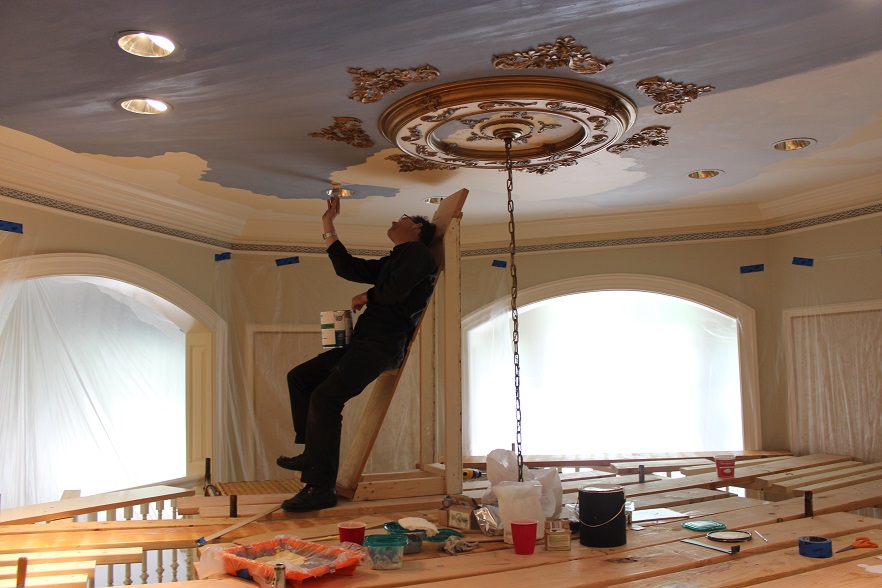
This year the clients asked me to paint the entire ceiling, so I had to make a design that would fit with the painting I had already done in the centre. The clients also allowed me to paint a few putti so long as they were "not naked" (even a crossed leg was not acceptable) Other than that restriction, and the comment that they wanted some birds, they actually gave me free reign to do what I wanted, which was very commendable.

Because of my perpetual problem of forgetting the memory card, this is the
closest I have to a "before" picture. This was at the beginning of the second
day of painting

The best way I could come up with to draw on the
ceiling; chalk taped to a stick

Neck-breaking work, this really gives a new appreciation
to the work that went into some of the great historical ceilings.

After one day of drawing and another of painting I realised I needed to come up with a better way to do this and save my neck. I thought of the method that Michelangelo supposedly used of making the scaffold high enough he could lie on his back, but this obviously would not work, because one thing an artist needs to be constantly doing is stepping back to observe his progress. (I achieved this by lying on the floor of my scaffold) In my opinion, what he probably actually did, was make a platform that he could move around on his scaffold and lie on that. I came up with a slightly less cumbersome, but not quite as effective, method of making a sort of chair. It had the advantage of allowing me to easily access my paint, but the disadvantage was that it still does not give as good of a perspective as lying down does. It also limits the area where one can work,and I was constantly moving it around. When I would get energetic and want to move from place to place quickly to work on multiple areas simultaneously, I had to just skip the thing altogether..


The clouds are finished here, I managed to get them to make sense with those I
had previously done in the medallion


The putti were drawn onto poster paper and then cut out to use as templates;
everything except the silhouette had to be done free-hand and therefore I
taped the drawing to the ceiling beside the painted in shapes to
 use as a reference 

Putti number two...

...three and four, plus a dove

This bloke looks terrible


As I began painting these figures, I realised how "rusty" I was at it. I had not painted figures in the past 8 years and I was never much for painting figures most of my life; add to that the additional challenge of painting upside down, and I really struggled to get going on this. I had intended to finish all four figures in one day, but at the end of that day, I had only done their silhouettes and this guy, which I was very unsatisfied with.


Another more detailed drawing, and a fresh start
made a difference, but it was still a bit of a
challenge.

The third one went better...
It only took a bit over three hours to get this one
finished.


Once the main ceiling was finished, I added a "faux" border to it, painted to
look like moulding.

Again, my template only gave me an outline, I then had to paint all the
details in by following my drawing. I first did the highlights, then the shadows.

After adding a few birds, I was happy with the results, as testified by
my signature

This little baby cloud escaped from his parents up in the sky and came down
to have a look into the room


And these two are trying, though not very hard, to catch a bird. I managed
both of them and the bird in four hours; the rust was beginning to loosen up


For me, art should be more than just a "picture"; it needs to have secret things, which must be searched out. it must have things that cause you to study it, and it should keep you finding new things each time you view it. To this end, even though the composition is simple, I have added many things for contemplation, such as the cloud, which at first glance someone might mistake for a "mistake". This causes you to have another look. and then, once you find the answer to this riddle, you might think to search for more. There are plenty, such as the putto with a bow, but no arrow; look at what his companion holds. Two other putti are engaged with a dove, though the dove is perfectly unconcerned with their playful attempts at catching him.


The finished ceiling as one sees it upon entering the house; as if he is looking
up into the sky.

And here it is seen as one reads a picture on an horizontal plain.
All of the moulding is illuminated as it would be from the natural light coming'
in the window. I used  models to check for the lighting effect for each section.