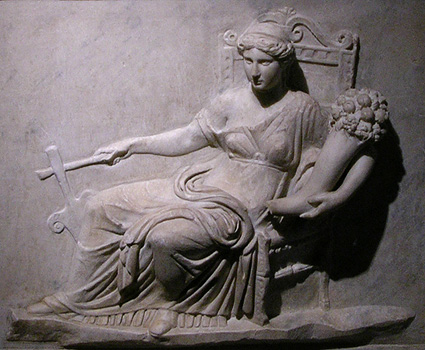
As already discussed in the introduction of this topic, here, a "throne" by definition is not a type of a chair or seat, but rather, the function of a seat as a symbol of state, by the person occupying it. In this post we will try to stay out of the weeds, but give some context into the ornamentation and various forms of the 'throne chair', which I am simply defining as a high backed chair of imposing form.
 |
| Detail from the Ashburnham Pentateuch (BNF Nouv. Acq. Lat 2334 fol 44r) In this illustration we see two men moving an empty chair of elabourate form |
I like the Ashburnham Pentateuch for its myriad illustrations of all manner of furniture and interiors as they were (representationally) at the onset of the Medieval Period. Though the Roman Empire had "collapsed" some 100-150 years before this manuscript was produced, we see that the Roman way of life and styles of furniture were still very much in vogue. In this illustration, which is part of a scene depicting the preparation of Joseph's brother's return to Canaan from Egypt, people are busy cleaning, packing, and preparing for a long journey.
Other 'throne chairs' depicted in this manuscript seem to be of the plinth chair form with a separate frame for a cloth hanging which gives the visual appearance of a "back" but is not something which the occupant can lean his weight against; this chair, on the other hand, is clearly a one piece unit, constructed in a manner which is still common to this day. The rear legs are taller than the front, have horizontal cross-members forming the back, and are joined to the rest of the chair at the rear of the seat and are further stabilised by stretchers joining the front legs. Throughout the entire millennium known to us as the "Middle Ages" this same basic chair type persisted; only changing in appearance by shifts in taste and fashion for the decorative elements.
There are not many pieces of furniture which remain from the early Medieval period, so whenever anything comes to light, it is of particular fascination to me. In 2001, excavation was going on in the centre of Rome, and an ancient Roman theater was uncovered. The remains of this building complex and later medieval buildings which occupied the site are collectively part of the Museo Nazionale Romano, and are known as the Crypta Balbi. According to their web page, in the 7th and 8th century this area had a workshop in the Exhedra, (an area built into a wall such as a chapel or a workshop; or even a seat if it is small) which produced luxury goods. Apparently, from these workshops came a bishop's throne; the few surviving fragments of which have been incorporated into a probable reconstruction of the chair, and are on view in the crypt.
The design of this chair is essentially the same as the remains of the so called St Peter's Chair which comes from the time of Charles the Bald of the 9th century, on display in the Vatican Museum, It is also not so different from an 8th century BC chair found in Cyprus. All three of these chairs I just mentioned are constructed of a wooden core with thin ornamental ivory plates affixed to the surfaces. They are in form, very similar to chairs depicted in 8th, 9th, and 10th century manuscripts, so they give us a good point of reference to help us interpret the artwork.
Not all such chairs would have been covered in ivory, as gilt metal and enamel plaques were also popular methods of ornamentation. In fact, I am quite sure that the entire gamut of ornamental options were available, depending on the amount the patron was willing to spend for the production of his chair. In the 7th century account of St Elugius (a goldsmith and member of the Merovingian court) there is a story of him having made two chairs of gold, ornamented with gems and semi-precious stones for King Clotaire (ca 584-629). These chairs would probably not have looked all that different to the chair from the Sacramentary of Charles the Bald, pictured below.
This chair form had staying power throughout the medieval period. An interior designer might quibble over the similarity of some of these designs from an ornamental standpoint, and they doubtless had some technical variations in their construction over the course of a millennium, but essentially this chair remained unchanged for thousands of years. I am speaking here as an archaeologist would see things; in the same way that he would find a relationships between Neanderthal and a modern humans, not in the way that an ethnologist finds differences between the Celts and Germanic people of early medieval Europe. (They were not the same people even though many early history enthusiasts like to treat them as one and the same)
The form of these throne chairs could have arched, triangular, or square backs, and could have panels and arms above the seat or not, as in the case of this 10th century illustration from the workshop of the monastery at Echternach. This manuscript has been attributed to the Meister des Registrum Gregorii, but, though it is very similar to his work, it is my belief that it was not done by the same artist. I would imagine it was more likely a member of his workshop. My basis for that assumption is that the illustrations are less technically detailed, (though that could be excused away by the speed in which their production required). A second argument that I give, however, cannot be excused away so readily, which is that the faces are not treated with such precision, and more importantly, the Grogorii Meister (master) makes his figure's fingers much longer than the artist of this manuscript.
Other 'throne chairs' depicted in this manuscript seem to be of the plinth chair form with a separate frame for a cloth hanging which gives the visual appearance of a "back" but is not something which the occupant can lean his weight against; this chair, on the other hand, is clearly a one piece unit, constructed in a manner which is still common to this day. The rear legs are taller than the front, have horizontal cross-members forming the back, and are joined to the rest of the chair at the rear of the seat and are further stabilised by stretchers joining the front legs. Throughout the entire millennium known to us as the "Middle Ages" this same basic chair type persisted; only changing in appearance by shifts in taste and fashion for the decorative elements.
 |
| Reconstruction of an 8th century chair using fragments found in the excavation of the Crypta Balbi, in Rome (see here for more information - in Italian) |
There are not many pieces of furniture which remain from the early Medieval period, so whenever anything comes to light, it is of particular fascination to me. In 2001, excavation was going on in the centre of Rome, and an ancient Roman theater was uncovered. The remains of this building complex and later medieval buildings which occupied the site are collectively part of the Museo Nazionale Romano, and are known as the Crypta Balbi. According to their web page, in the 7th and 8th century this area had a workshop in the Exhedra, (an area built into a wall such as a chapel or a workshop; or even a seat if it is small) which produced luxury goods. Apparently, from these workshops came a bishop's throne; the few surviving fragments of which have been incorporated into a probable reconstruction of the chair, and are on view in the crypt.
The design of this chair is essentially the same as the remains of the so called St Peter's Chair which comes from the time of Charles the Bald of the 9th century, on display in the Vatican Museum, It is also not so different from an 8th century BC chair found in Cyprus. All three of these chairs I just mentioned are constructed of a wooden core with thin ornamental ivory plates affixed to the surfaces. They are in form, very similar to chairs depicted in 8th, 9th, and 10th century manuscripts, so they give us a good point of reference to help us interpret the artwork.
Not all such chairs would have been covered in ivory, as gilt metal and enamel plaques were also popular methods of ornamentation. In fact, I am quite sure that the entire gamut of ornamental options were available, depending on the amount the patron was willing to spend for the production of his chair. In the 7th century account of St Elugius (a goldsmith and member of the Merovingian court) there is a story of him having made two chairs of gold, ornamented with gems and semi-precious stones for King Clotaire (ca 584-629). These chairs would probably not have looked all that different to the chair from the Sacramentary of Charles the Bald, pictured below.
 |
| Folio 3r Sacramentary of Charles the Bald BNF Lat 1141 ca 1169-70 |
This chair form had staying power throughout the medieval period. An interior designer might quibble over the similarity of some of these designs from an ornamental standpoint, and they doubtless had some technical variations in their construction over the course of a millennium, but essentially this chair remained unchanged for thousands of years. I am speaking here as an archaeologist would see things; in the same way that he would find a relationships between Neanderthal and a modern humans, not in the way that an ethnologist finds differences between the Celts and Germanic people of early medieval Europe. (They were not the same people even though many early history enthusiasts like to treat them as one and the same)
 |
| BNF Lat. 8851 fol 115v Evangelist Portrait of St John 10th century |
The form of these throne chairs could have arched, triangular, or square backs, and could have panels and arms above the seat or not, as in the case of this 10th century illustration from the workshop of the monastery at Echternach. This manuscript has been attributed to the Meister des Registrum Gregorii, but, though it is very similar to his work, it is my belief that it was not done by the same artist. I would imagine it was more likely a member of his workshop. My basis for that assumption is that the illustrations are less technically detailed, (though that could be excused away by the speed in which their production required). A second argument that I give, however, cannot be excused away so readily, which is that the faces are not treated with such precision, and more importantly, the Grogorii Meister (master) makes his figure's fingers much longer than the artist of this manuscript.
 |
| Meister des Registrum Gregorii This illustration comes from the book which this unknown painter is named after; it is added here for comparison to the above work. |
Whether this illustration was painted by him, or someone of his circle of influence, is not so important as the fact that the Registrum Gregorii Meister's work was so renowned that it influenced other work for over a century. The following illustration, also a portrait of Pope Gregory the Great, from some 60-80 years after that of the Gregorii Meister, bears witness to this fact. Though this chair differs from the others in that it has no panels, its structure is essentially the same concept. Other illustrations from the 10th century are more like the previous examples, but I wished to show this example to demonstrate the longevity of ornament, as influenced by one artist or school of artistic thought. Both the centres of St Gall and Echternach, where these three works were produced, exerted a far reaching impact on book illustrations of the Ottonian world.
As time wore on, the throne chair did not so much change, as adapt the various trends in fashion and ornamentation. In the British Museum can be found a lovely collection of ivory chessmen which are believed to have been created in the first half of the 12th century. Known as the Lewis Chessmen, these pieces give wonderful representational designs for chairs done in the Romanesque taste of ornament; namely interlace and foliage, known in German as Flechtwerk and Rankenwerk (Flecht means to weave, and Ranken is a vine tendril). In many of the objects created in the 11th and 12th centuries the taste for panels with enamels and gems gave way to ornament of this type. This is an oversimplification, however, as the 11th -13th century was the "Golden Age" of enamel work from Mosan and Limoges, and the objects produced in these workshops went into the decoration of just about any sort of furniture one can think of. Nevertheless, as featured in other postings on this blog, there are actual surviving chairs from this period which prominently feature this vine and weaving type of Romanesque ornament.
 |
| Pope Gregory receives Inspiration from the Holy Spirit St. Gallen, Stiftsbibliothek, Cod. Sang. 376, zt. 82 ca 1050-70 |
As time wore on, the throne chair did not so much change, as adapt the various trends in fashion and ornamentation. In the British Museum can be found a lovely collection of ivory chessmen which are believed to have been created in the first half of the 12th century. Known as the Lewis Chessmen, these pieces give wonderful representational designs for chairs done in the Romanesque taste of ornament; namely interlace and foliage, known in German as Flechtwerk and Rankenwerk (Flecht means to weave, and Ranken is a vine tendril). In many of the objects created in the 11th and 12th centuries the taste for panels with enamels and gems gave way to ornament of this type. This is an oversimplification, however, as the 11th -13th century was the "Golden Age" of enamel work from Mosan and Limoges, and the objects produced in these workshops went into the decoration of just about any sort of furniture one can think of. Nevertheless, as featured in other postings on this blog, there are actual surviving chairs from this period which prominently feature this vine and weaving type of Romanesque ornament.
 |
| One of the 12th century Lewis Chessman from the British Museum |
Regardless of the elements of ornament, this chair still illustrates the basic principle of square corner posts and a panel back; (it also has side panels and shorter front posts, not visible from this angle) in this case the round finials have given way to carved animal heads. This might have been a variation which had persisted throughout the Middle Ages as well. Many illustrations from every century show them as terminals on the "X Chairs" so there is no good reason to doubt carved animals could have been used on these throne chairs as well. (They are also very common on throne chairs of the 14th and 15th century, as observed in artwork and actual surviving examples.)
 |
| Shrine of St Valerie, sold on Christie's Late 12th or early 13th century |
Sadly, I did not have an odd 50,000£ lying under my mattress, so was unable to purchase this lovely champlevé shrine when it came up for sale on Christie's a couple years ago. Because it is a shrine, the proportions have been somewhat altered, but this is still our basic throne chair made of gilt bronze and enamel. This is one of those products which I mentioned, coming from Limoges. As far as I know, there is no actual surviving chair made of this sort of enameled gilt bronze, but given the host of chest fittings, reliquaries and, caskets made in this manner, it would seem very probable that such chairs were also produced. Without a doubt, plaques of this type of ornament would have been affixed to the wooden structure of other chairs, giving a very bold and glittering appearance.
 |
| Coronation Chair of Westminster Abby 1296 |
Bold and glittering is certainly how this coronation chair of King Edward's would have appeared when first constructed in 1296. It was covered in gilded gesso with figures and diaper (repeating foliage or floral pattern) ornamentation; further enhanced by transparent glazes of colour to pick out certain elements of the design. Leaving off the cusps and crockets of Gothic ornament, this chair essentially brings us right back to the 8th century Italian one we began with. Disregarding 700 years of abuse and continual use, this chair is also a wonderful testament to the degree of sophistication that existed in a period from which most people still hold the view that the furniture was of the coarsest form.
I have brought you, century by century, through almost the whole of the Middle Ages here. We have now arrived at the 14th century and though there are hundreds of illustrations to choose from, both in manuscripts and painting, as well as sculptures and even actual chairs, I have chosen this one to hammer home a bit more, the last point I made.
 |
| BL Yates Thompson MS 21 fol 69v |
Save for the baldaquin (overhanging 'roof') this chair is still basically the same as the others, having corner posts and panels to the sides and back. It comes from a ca 1380 addition of Roman de la Rose, a popular late medieval romance novel. I wanted to use it in order to contrast it with the following illustration, which comes from the same book. In the illustration above, we see representations of a fairly sophisticated and well ornamented study. The chair has carved panels, and the posts have elabourately turned elements. (One post has been omitted by the artist in order to avoid confusion, as it would have been mostly hidden by the lectern.) A highly carved and ornamented lectern stands in front of the seated scribe, and a revolving, adjustable round desk is placed to the side.
 |
| BL Yates Thompson MS 21 fol 4r |
By contrast, the single unadorned (at least as it is depicted here) chest in this illustration would seem to speak of a very humble ill-furnished room. This illustration seems to be the model by which many people judge the furniture and furnishings of the medieval world, but this view completely ignores other illustrations such as the one above, and more importantly, all the actual artifacts which demonstrate that people in the Middle Ages loved to ornament their possessions.
The richest kings, popes, and emperors would have had chairs of gold, or some other material covered in gold and gems, but other, slightly less well off rulers wishing to emulate that style, could have had gilded copper and enamel or glass. Still further down the economic ladder, one could have had gilded gesso and paint. Once any hope of gold ran out, there was still the option of bronze, and below that, brightly painted objects.
If we look at the early modern period, when enough objects associated with a particular individual survive to give us a clear impression of their possessions, and compare that to the writings of the classical writers of Rome, (backed up by physical evidence from places such as Pompeii) we can see that people have not really changed much. The more money and power someone has, the more lavish his goods. In the will of Charlemagne is mentioned four elabourate tables made of either silver or gold; kings and emperors did not have crude unadorned furniture. People of lower social or economic situation have always striven to emulate, to the best of their ability, the tastes and fashions of their social and economical superiors. Even peasants of the 15th and 16th centuries had brightly painted furniture, why can we not assume then, that the same would have held true for the 12th or the 9th?
 |
| A 15th century throne chair and associated wall paneling in the Cluny, Paris |
One thing that the study of a two thousand years of European furniture has revealed, is the slow change which took place in the basic forms and methods of construction. In a previous post, I showed a chair from the 6th century grave find of Trossingen, Germany, and how it differed very little in fundamentals from a chair of 17th century England. Museums and history books often quibble over whether such and such a piece was made before a certain date because the drool that dripped out of the makers mouth had a particular element not known in people's diets before a certain date, or some such thing. This is an exaggeration of course, but we often get lost in the forest and never see the trees. A certain design or technical element may well date a particular piece to a specific date, but this says nothing of the possibility of a very similar object existing in a much earlier time period. Throughout the Middle Ages, we can be certain, that throne chairs existed, and were not confined to the use of Kings, as thrones. They were also made for people's private use, and the degree of their decoration had as much to do with the amount the patron spent in their manufacture as to the their ultimate function or ownership.
Videre Scire