Showing posts with label 8th century manuscript. Show all posts

Saturday, April 4, 2015

The (Long and complex) History of the Medieval Chair - part 1; Type-forms

There has been a lot written and discussed, concerning the chair, in the context of history and society. These discussions have often been influenced by our modern concepts of history and craftsmanship, they have also been clouded by an overlap of terms for different types of seating furniture. One of the most common misnomers on the subject, is the word "throne", which people often associate with large, elaborate, and ornate chairs; another is "stool" which is usually thought of as a simple or primitive object. This posting will address the basic types of chairs found in the artwork, (and surviving examples) of the Middle Ages; future posts will discuss the development and ornamentation these types of seating objects have taken.

To begin with, lets establish some basics of definition, utilising terms as we understand them today, then explain how those might have differed in various times in history. As was already mentioned, the biggest sticking point, in the discussion of chairs, is what constitutes a 'chair' as opposed to a 'throne'. The simple answer, based on the Oxford Dictionary and Wikipedia, is that a throne is a chair which is used in the context of a ceremony or official function. Adopting this definition, a three legged 'cricket stool' would be a throne, if a king or pope were sitting on it, in an act of office. By contrast, a massive carved and gilt ivory chair in a farmers house, (were he to, somehow, acquire such) would still just be a large and elaborate 'chair'. We can thus conclude that a throne is not a form of furniture, but any type of chair, with a specific function.

Whenever histories of medieval western furniture are discussed, it is helpful to introduce the topic with the origins of those objects, when their origins fall outside of the Middle Ages. This is most definitely the case with chairs, so we should have a quick check on what was used in antiquity, (meaning before the medieval period). In the case of chairs, I think it would be almost impossible to say, with any kind of empirical certainty, when they first appeared. There are, in the Athens Archaeological Museum, several marble sculptures of musicians, sitting in chairs, playing harp type instruments; these sculptures are thought to be nearly 5000 years old, so obviously chairs are even older than that.

Harp Player From Keros c2700BC as seen in the MET


If we jump to the Roman world, which is much closer to the time of our discussion, we find several bronze chairs and other types of seating furniture from Pompeii. Many extant depictions of various types of chairs in Roman artwork, as well as a couple charred remains of actual pieces, can be found in various museums around the world. We will use these examples to begin the study of how chairs did, and did not, change through the progression of the Middle Ages.
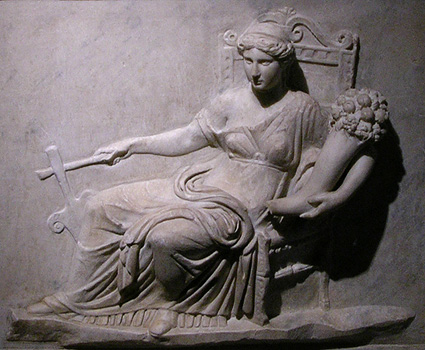
The Goddess Fortuna in the Capitoline Museum
(linked direct from website)


The above example is a marble relief depicting a chair made of bronze, several actual examples of which have been recovered from archaeological sites of the Roman world. This is a very basic form, as we know it today, of a chair. The fact that this chair is represented as being made of metal, as opposed to wood, is immaterial. There seems to have been a large quantity of metal furniture made throughout the Roman and medieval periods, and any serious discussion of medieval furniture must include non wooded furniture as well. In the museums we find many Roman examples of bronze chairs, and at least three (the "Dagobert Chair" from the 7th century, the 11th century "Kaiserstuhl" from Gosslar, and a remarkably elaborate 14th century gold and enameled Gothic style chair in Barcelona) from the Middle Ages. There also exists, in manuscript illustrations, several depictions of chairs which clearly indicate metal furniture. Even if these are the only three which I have mentioned, and there are not many others still in existence, they speak forcefully of a tradition of metal-fabricated furniture, which must have continued throughout the Middle Ages, as any type of industry needs continuous business in order to survive. In addition to chairs made of metal, there was also an ongoing practice of making objects of wood, and then covering them in gold or other metal foils, and further enhancing them with gems, crystals, and enamel.

The form which we associate today with the term 'chair', is that of one having four legs, and a back; if the front legs extend above the front of the seat and are connected by a cross member to the back, we term that an "armchair". An elaborate version of such a chair is what we usually associate with a "throne", so this will be our first form of chair; we will call it a "throne chair", though, as already stated, a throne indicates a function of a chair, not its form. When I discuss this form in greater detail, we will examine variations to this basic shape, but for now, here is one example of such a chair.


Shrine of Sainte Foy, Conques Abbey
originally 9th, century but with 10th
and 11th century alterations


This happens to be another example of a metal chair, but a piece of furniture of such form could just as easily have been made of wood or even stone, then covered with foil and other ornaments. In fact, the "Throne of Charlemagne" in Aachen, is very similar in form to this, and it would be ludicrous, given the opulence of other surviving objects associated with him, to believe that, as originally fashioned, it would not have also been ornamented in a similar manner.


As I am terming this type of chair a 'throne chair' I will make another category of objects of similar form, but less ornate in decoration, and call it a "common chair". Because we are discussing form, not function, we will find many pictures of kings, bishops, and other persons of importance, sitting in such chairs, these are, none the less, 'common chairs' in form. In the Middle Ages, these chairs usually were constructed with turned upright members, and often had turned horizontal elements as well. the complications begin to arise when we find such chairs ornamented and elaborated on, to the point of becoming 'throne chairs'; many examples of which can be found in medieval artwork. With these first two types of chair, it is often difficult to decide where to draw a line of distinction.


Isaac sends his son to hunt, in this detail from folio 25r 
of the 6th century Ashburnham Pentateuch
BNF Nouv. acq. lat 2334

In this illustration, Isaac is dispatching his son Esau on his infamous hunting expedition, as his wife, Rebecca, stands behind him; very conveniently, the artist has identified the figures in this picture. Isaac sits in a turned armchair with finials on all four uprights, but, since the back is directly in line with two of the columns, it is difficult to tell where the finials end and the columns begin. (This sort of problem was what later medieval artists attempted to avoid, as was discussed in last weeks posting.) In addition, but very difficult to discern, Esau is either siting on, or standing in front of, another turned chair or stool; one leg of which is green, the other lavender, both legs of which have splayed feet.

The study of this Pentateuch is most rewarding for anyone interested in early medieval furniture, as the illustrations are full of all sorts of examples of such. Since this book was produced at the beginning of the Middle Ages, (its exact date is disputed, as either late 6th or early 7th century) it gives us a reference to many forms of furniture which were in use at the onset of the medieval period. Nearly all the basic forms of seating, which will be discussed in this blog, are present in these early illustrations.

Another common type of seating form, found throughout history, is the stool. This type of furniture, in our modern thought, is a simple and seldom used item; it can still be found in many homes, but is usually relegated to an object for accessing places too high to reach when one stands on the floor. This type is most often constructed of wood in a very simple, unadorned, manner. By our current definition, a "stool" is a piece of seating furniture, having three or four legs (usually) and no back. Another form of this which seems to be rather modern in invention, (post medieval) is the "bar stool", which is a high legged stool, but, because of its late entry into the world, will not be discussed further.

Although we usually associate the stool with a simple, even primitive, object, this was not always the case. There are many illustrations of kings, emperors, popes, bishops and the Virgin Mary, seated on, often very lavish, stools. Because a stool form, in its broadest context, can be more simple than a chair, and we can find very ancient examples of it, people often assume it came before the chair. This is a case, however, which I believe is not possible to prove in a definitive way. In most historical contexts where we find stools present, such as Egyptian pyramids, or the ruins of Knossos, we find chairs as well.


Seated Madonna, seen from the rear.
New York Metropolitan Museum of Art
12th century


By the definition of having legs, but no back, this is a 'stool', but is certainly much more elaborate than our modern concept of such items of furniture. I chose this example because it has five legs as opposed to the usual three or four. This example also offers some idea of the ornamentation which could go into such a piece of furniture. Much of the paint has crumbled away, but there is still ample evidence of the manner in which it was decorated; further, there are some bits of a three-dimensional gesso remaining, which hint at additional ornamentation. This decoration is hard to make out clearly, but it consists of foliage and reel-and-dart mouldings in the spandrels.

A similar form of seating which is found throughout the medieval period, but no longer exists today, is what many people often mistake for a "chest". Though I have never found any discussion of this form of furniture in books or online, it is the single most common type of seat depicted in medieval artwork, (based on more than 5000 illustrations which I have, at present, already studied). Since there seems to be no name for these seats, I have termed them "plinth chairs". Just for curiosity, I typed that term into a Google Image search window, and what was revealed has nothing to do with a plinth at all, so I am not sure how one gets "plinth chair" from a doctors examination apparatus, but I will leave modern things to those interested in such.

A "plinth" is an architectural element to support a structure, or part thereof, (i.e. columns) or to support an object such as a vase or sculpture - or, in our case, a living person. A plinth is an interface between an object and the ground, and as such, this seems to be the perfect description for this type of chair. A case for the fact that these chair depictions are distinct from chests can be made from three points, The first is that in many of the depictions, the indentation to the main body, as compared to the base and the seat, make it quite impractical as a useful chest. The second point, is that in no single example of this type of furniture, have I seen a depiction of a lock, whereas, they are almost always portrayed on chests. In fact, a lock is one type of imagery which medieval artists used to designate an object as a chests. (One could argue that a person sitting on such an object would obscure the lock, so this point alone, is rather weak evidence.) The third, and best argument, comes from the fact that in many manuscripts, one can find both 'plinth chairs' and chests in the same manuscript, and sometimes even in the same illustration; in these cases, it is very easy to see that the artist was portraying two distinct types of furniture.

St Luke Composing His Gospel
BNF Lat 17968 fol 83v
first half of the 9th century

Here we see St Luke in a contemplative posture, as if pondering the gravity of what he has just written; his chair is clearly distinct from the chest which stands beside him. It is also worth pointing out that both of these pieces of furniture depict panels in their sides. Notice, also, the lock in the front, and the hasp to the lock, on the lid; symbols used to indicate a chest. The plinth chair, which may or may not be able to double as a storage device, has no indication of being anything other than a seating apparatus, in this illustration.

Another form, related to the armchair and the plinth chair, is a "box chair", This type is not found in the Ashburnham Pentateuch, but versions of it can be found in early 9th century manuscripts and possibly some of the Insular Art, of the 7th and 8th centuries, though it is often hard to tell exactly what they are portraying, due to the great abstraction of form that this art style takes on. In essence, a box chair is a plinth chair with a back, or in some cases, a back and partial sides. Two famous medieval chairs which have actually survived, are of this form, viz the 9th century,so-called, St Peter's Chair, and the 6th century Chair of Maximian. Perhaps, the already mentioned Kaisers chair of Gosslar, falls into this category as well, though its base is a solid block of stone, as opposed to a box.


Chair of Archbishop Maximianu of Ravenna
Archiepiscopal Museum, Ravenna
6th century (from Wikipedia) 

Though the 'plinth chair' is the most common seating form depicted in medieval artwork, a close competitor would be the "X chair" in its several forms. The folks over in The Netherlands, who have been doing their St Thomas Guild blog for the past four years, (and were my inspiration for starting this one) have already posted a lot of information on this type of chair and its various subcategories, they even featured a finely preserved Danish example which is over 3000 years old. Most of the depictions of these 'X chairs', from the Middle Ages, have animal head and feet terminals to the legs; some of them seem to have been very large and ornate. Other depictions of these chairs, however, are of a simple metal from, very much like many of the bronze examples recovered from the ashes of Vesuvius. 


Relief sculpture on St peter's Church, Utrecht.
c1200
Though much more common in paintings, these "X chairs"
can be found in sculpture as well.


In the artwork from all periods of the Middle Ages, we also find "benches". These pieces of furniture can take on any and all of the various forms of chairs and stools. I even have one illustration of a double length 'x chair' though I am not sure how possible such an apparatus would actually be. As I have said before, medieval illustrators were not concerned with reality, so much as a concept, and placing two or more rulers on one bench was simply a way to portray the notion of co-rulers. Some of the best examples of this concept can be found in illustrations from the Book of Revelation, in which John mentions "twenty four elders, seated on thrones, judging...", in many examples, the artist drew two long 'throne benches' each with twelve occupants. There is probably no way to know if such benches were made for any real occasion, perhaps at a tournament, or a synod of bishops, but regardless, it would obviously be possible for someone to make such a thing, should the need arise. There are a some actual late medieval benches which have survived, the earliest I know of, coming from the 12th century. One example of these benches are three individual items made of stone, and can be fiund in the 13th century Norman Castle of Gioia del Colle, in southern Italy. A second example comes from Gamla Uppsala in Sweden, this is a turned wooden bench which supposedly belonged to a bishop of the church there, and is of late 12th century construction. I swiped this image from St Thomas Guild because, right now, I cannot find my picture of another similar, even longer, bench which is in a church ambulatory in Northern Germany.


Late 12th century bench from Sweden

Of course, we can also mention the numerous surviving examples of choir stalls found throughout Europe, some of which date back the the end of the 12th century. These fixed units are no more than benches with individual dividers to separate each occupant from his neighbour. Many of these stalls have high paneled and carved backs, with baldaquins or canopies overhead, very much like those found pictured in contemporary medieval manuscripts.

Not so easily classified as the preceding forms, are other types of furniture which are rather like "none of the above", and for the use of this blog, I will term as "other seating forms" These include alternate shapes to plinth chairs, as well as chairs made from barrels or even hollowed from logs, and chairs with elaborate backs or bases. The best way to understand this category will be to wait until it is explained in its own future posting. Here is one example, however, from the British Library's Harley manuscript collection. 


St Luke Composes His Gospel
early 9th century


In this example, we find St Luke seated on some sort of barrel shaped chair with scrolled brackets supporting the drapery behind him. This chair seems to be round in diametre and bombé in form, which means that the French of the 18th century did not invent this form of furniture, though, perhaps, they did in the 9th? (sorry Encyclopedia Britannica). Although it seems to have a base to it, as a plinth chair, chest, or box would, the artist has indicated short feet on it as well. The "back" of this chair is not a back, as we understand it, nor were many of the other chairs illustrated in this period of the Middle Ages. Persons of importance have always, on ceremonial or important functions, been seated in front of ornate draperies or tapestries which are termed a "Cloth of Honour". It is the hanging apparatus for this sort of drapery that is depicted here, in what looks to our modern eyes, like a back. In many other medieval illustrations, which show this part in more detail, we see that there is no structure, save a top rail, which could support a sitter, were he to lean back against it. (This, in no way, is intended to suggest that chairs of this type could not have back, as many other illustrations clearly show they did.)

Lastly, in this group of furnishings which we are discussing, comes a piece of furniture, which is not actually a seating implement at all, but which, none the less, must be covered in a discussion of seating in the Middle Ages. This device is called a "foot rest", and was indispensable to nearly anyone sitting in a chair in the time period of our topic. Like the chairs which they accompanied, they had almost endless possibilities in form and ornamentation. The last illustration actually shows two of these, but I rather suspect that the second one was added to compensate for the fact that the evangelist's feet would not reach the first one, as the artist had positioned it. This theory is supported by examining other works which seem to be produced by the same artist, none of which have a second foot rest, and also, by its awkward relative position.

When one wishes to catagorise nearly anything, they will soon run into problems of exactly where to put some items, overlaps of multiple catagories, and items which just do not neatly fit into any single segment. The same is true for this attempt at breaking down the various types of chairs illustrated during the course of the Middle Ages. Often, life does not willingly fit into nicely packaged boxes. Our catagories of, Throne Chair, Common Chair, Stool, Plinth Chair, Box Chair, X Chair, Bench, Foot Stool, and Other Seating Forms, should cover most of what was made in the medieval world of Europe. In future postings, I will be examining each of these types in more detail. A longer term goal of mine is to actually make a chair from each of these catagories.


Videre Scire


Note to readers; Several of you have sent private emails to me, stating that you were not able to post comments to this blog. When you wish to add a comment, you must first be sure that Google has recognised that you have signed in, Even if you are already signed in to your Google, (or other supported system) you must still sign in again within the blog before you attempt to publish your comment. You accomplish this by clicking on the appropriate icon in the top right-hand corner of the comment dialog box, or by entering your email address where prompted. If you do not see your name in the "commenting as" box immediately above the comment box, your comment will not register.

Cheers

Sunday, March 8, 2015

It has nothing to do with the age...

Most people have the general idea that everything coming from the roman period was superbly made with perfect symmetry and form,  but, after the "fall" of the empire, Europe was swept into an abysmal "dark Age" from which it took a thousand years to slowly crawl back out. Along with this notion comes its twin, which is the idea that the farther back one goes in the Middle Ages, the more primitive things become. While this may be true to some extent in certain regions and during certain eras, I am dedicating the remainder of my life to utterly shattering that myth as a universal, all encompassing truth.  The reality is much more nuanced and complex. Basically put, time has nothing to do with the quality of the creations that the talented and gifted craftsmen and artists produced during the millennium which we call The Middle Ages. This blog posting will begin to show the truth of this statement.

The following page, from a late 8th century manuscript in the St Gallen Archive, illustrates quite nicely most people's perception of pre-14th century medieval art in general. There is no denying that it is rather naive and primitive in appearance. The "barbaric"/Celtic forms of art are here in their most vivid form, therefore, proof of a standard much lower than what came before...or is it?

A medieval scribe is illustrated in this
civil document from the early stage of
Charlemagne's reign.
St. Gallen, Stiftsbibliothek, Cod. Sang. 731, zt. 234
Here is another page from a different manuscript of the same time period (within fifteen years). The Bibliotheque Nationale states this work as "around 800", but "before 814", Wikipedia however, says it is from about 827, Perhaps they know something the folks in Paris do not?

St Luke Composing his Gospel from the
Gospels of St Medard of Soissons
BNF Lat 8850 fol 11v
I have spent a lot of time pouring over medieval manuscript images, ones that the average person would consider dull and boring; decorated initials and illustrations of columns and arches like those above, which are called Canon Tables, and are used to notate similar passages of scripture among the Four Evangelist. Many of these tables are much simpler than this one, and a few are even more elaborate. Much can be learned from these types of illustrations; even though they usually do not portray any sort of 'picture', (as this one does) they can lend great insight into the manner of ornamentation used at the time of their creation, and show us the quality of workmanship which could be found in their era of execution. Another thing that can be observed about the images from this early time period, is the seeming rivalry between the 'Roman' model and the 'Celtic' mode of decoration (I will use the term "early" to refer to the 6th through 9th centuries, "middle" for the 10th through 13th, and "late" for those of the 13th through 15th. [yes there is some overlap; 1000 cannot be divided neatly into three equal centuries.] I also know that the first 'third' is actually weighted more than the others, but this is to distinguish the phases of development that more or less occurred in the style of art during these time periods. Furthermore, the split between middle and late would better be placed at the second quarter of the 13th century than at is close.). In many manuscripts, one finds either one or the other, wholly, whilst in others there can be a mixing of both types of artwork in separate illustrations, or, even mixed together in the same illustration. The first example would be one of wholly Celtic style, the second, that of a completely Roman model. 

It may surprise some readers, but in reading the 6th through 9th century contemporary writings of persons living in the regions formerly under the control of the Roman Empire, such as Gaul and Germania, the writers spoke of themselves as "Roman" and distinguished themselves from the "Barbarians", who were, by their definition, "not Romanised" Thus, while modern scholars consider the Roman world to have "collapsed" about 500 AD, no one bothered to tell the people living at that time about it, and they went right on considering themselves Roman. The whole bit about Charlemagne being crowned in Rome was to give legitimacy to him as a "western" Roman ruler, as opposed to the "Roman" rulers of the eastern realm, known in English as the Byzantine Empire, but in German as the Oströmische Reich, which translates to English as, the Eastern Roman Empire; this is precisely how it was viewed by contemporary peoples of both regions. (Of course the eastern half also wanted to, and did try, to re-unite the two halves under their control.)

Back to the above illustrations, I can imagine hearing many readers, familiar with the time of Charlemagne, saying, "but just a minute, that second illustration is from the 'Carolingian Renaissance School' also known as the 'Court School' and thus is an exceptional example from a brief bright spot in an otherwise dark age." Well, thank you, I am glad you brought that up, because again, like the first notion which we are discussing, this is a mixture of truth and rubbish...read on.

This next Illustration is another one of those Canon Tables which I mentioned a minute ago; however, in this case, someone never got 'round to filling in the appropriate text. This table is from "some time between 736 and 760", and thus earlier than Charlemagne's ascension as king of France, (768) and at the very least least, forty years before his coronation as Emperor in 800 AD. It is true that after he became Ruler, he did set up a "Court School" to promote the dissemination of learning and the arts throughout his realm, but in order to set up such a school, there must have been available talent, willing and able to come and teach at said school. The blind cannot lead the blind. Charlemagne went throughout the known (to him) world and recruited people (actually his agents did) from nearly every country, thus, there already was an established 'pool' of skilled craftsmen to pick from, before his school was begun. Given politics being what they are, and have always been, this does not even mean to say that the best were necessarily selected, as opposed to the brother's cousin, or the prime minister's best friend etc. etc.who was good at one craft or another and, some favour or other was either given or gotten in the deal. This canon table shows nearly the same level of craftsmanship to that executed by the creator of the second illustration above, yet whomever produced it would, in all likelihood, have been dead and gone before that famed school was ever conceived of . In a world in which students learn from their masters, under a system of apprenticeship, it is actually quite hard to completely erase a skill or craft. 

BL Add. MS 5463 fol 1v
That fact causes me to be baffled, when, in the context of the development or loss of skills and trades, I am confronted with the notion that somehow, whilst the arts of weapons, fabrics, and building continued to evolve and improve during the course of the Middle Ages, people expect me to believe that the art of making furniture was nearly snuffed out, to the point of furniture makers resorting to "dug-out chests, and planks set on tree trunks as tables". I am not making this up, I continuously come across such descriptions of furniture as being the types of furnishings used during the "early" (usually pre-14th century in these writings) middle ages. The following picture is from a Museum in Germany, and is talking about the "earliest forms of a chest" It says the word originated from meaning a tree, and that chests in the earliest time in history were so constructed; and continued to be used in remote places such as alpine valleys, long after the close of the Middle Ages.


To be fair, this museum did not define "earliest time in history" but most people reading this, seem to interpret it to mean "...of the Middle Ages" It is quite probable that at some point in neolithic history, chests were originally made in this manner, but we can go back as long ago as the Minoan civilisation and find representations of chests made with a post and panel construction.

This clay model of a chest comes from the 14th or 15th century BC
(that is 3500 years ago) and clearly shows one of the same forms
 used until at least the 13th century AD in Europe.
Just as the placard in the museum states, however, in some regions of Europe, log chests were made even into the 17th century. A few years ago this two part log chest was for sale at Christies; it was made in the second half of the 16th century.

A "primitive, medieval" chest; except it comes from the
Renaissance; the "age of enlightenment". It is contemporary
with some of the finest furnishings in the top museums.
These two pictures, alone, should demonstrate what was said in the title of this blog; that time had nothing to do with the quality or craftsmanship of an object. I want to knock a few more holes in most peoples notions of the quality of furniture during the medieval period before I go on, however. I mentioned something about planks set up on tree stumps for tables as well. I saved that statement and its source in my files, but it has since been lost and I have not found where I read the original statement again. I do have, though, from the will of Charlemagne, at his death, a brief description of a few of the items he had in his possession. The source of this is from Einhard's Vita Karoli Magni and though the description of most of his possessions are not very explicit, there is one delicious tidbit of information;  ...it is well known that among his other property and treasures are three silver tables, and one very large and massive golden one. He directs and commands that the square silver table, upon which there is a representation of the city of Constantinople, shall be sent to the Basilica of St. Peter the Apostle at Rome, with the other gifts destined therefor; that the round one, adorned with a delineation of the city of Rome, shall be given to the Episcopal Church at Ravenna; that the third, which far surpasses the other two in weight and in beauty of workmanship, and is made in three circles, showing the plan of the whole universe, drawn with skill and delicacy, shall go, together with the golden table, fourthly above mentioned, to increase that lot which is to be devoted to his heirs and to alms. (from the Medieval Source-book; this text translated from Latin in 1880)

None of these tables sound anything to me like planks set up on tree trunks! There is, in the 8th century biography of St Eligius, a brief story of him having constructed two chairs of gold and precious stones for the king, these, also were obviously sumptuously made, and had nothing to do with the general image most people have of early medieval furnishings. No one, today, knows exactly what those chairs looked like, because they have long since succumbed to the ravages of time, but there is a chair, from roughly the same time period as those made by St Eligius, which is now housed in the Bibliotheque Nationale, in Paris, and is said to have belonged to Dagobert. It has no jewels or precious stones, but it is still a very well crafted and beautiful chair.
You may look it up yourself on the internet, as there are many images of it, I chose to show this detailed view to demonstrate the skill involved in its making. Since it is cast of brass, this attests also to an whole other line of craft and the skills required to produce such an object.

So far, we have looked at objects from the end of the first third of the Middle ages, what about the 10th,11th and 12th centuries? Surely they were the bleakest of times, and the superb skill and exquisite craftsmanship had vanished by then, right?    Wrong.
Detail of the Dagobert Chair from the end
of the first third of the 7th century

Ivory reliquary in the V&A
mid 11th century


Obviously, someone still knew how to carve ivory in the 11th century...

Heinrichskreuz from the Quedlinburg treasury
early 11th century
they could still apparently work gold and gems...

Meister des Registrum Gregorii
Trier Stadtbibliothek
c985
And without a doubt, this shows that they yet retained the skills to paint.

Years ago, when I first saw an image of this painting, I thought it was a fake, because, I too, had been fed the same notion of the primitiveness of medieval art and could not believe this was produced slap bang in the middle of the "darkest" period of the Middle Ages. On doing more research, I discovered what I am sharing with you now, and continue to discover more of, to this day. These discoveries are, as I said, that there were, in fact, times and places during the course of the Middle Ages, in which primitive, naive, and crude objects were produced; however, at the same time, there were always craftsmen of superb talent who produced impeccable objects demonstrating skill and craftsmanship. 

Please look carefully at the five pieces of furniture depicted in this painting and tell me which one of them looks like it was hewn from a log. The desk alone should dispel anyone's lingering doubts about the existence of finely made medieval furniture. 

From the 12th century, we find, in the Minden Cathedral, an altar or pulpit, which at one time was the back panel of a chair, probably belonging to one of the bishops of the cathedral. There is a book (which seems to be out of print), which is titled, Schatz der Staufers, or something of the sort (not the children's comic book by that name in print now) which featured several beautiful 12th and 13th century carved pieces of furniture, This panel is featured among them in an old photograph, dating from some time in the 19th century; it is depicted with its legs still attached. It is instructive to consider, when viewing such items as any of those which I have featured, that though these might be isolated objects and very rare in terms of their survival, that they did not just appear out of thin air; someone made them, and he did not just make one such object. Each of these pieces is testament to an entire career of a craftsman and his work. 

Former Throne, now as a pulpit front in the Minden Cathedral
Mindener Dom Altar, Ehemaliger Thron des Kaisers um 1170
Bildausschnitt
I have come up with a phrase I like to use, which is that, "A lack of existing evidence is not evidence of a lack of existence.". Happily, though, there is plenty of evidence to prove that although there was plenty of the "crude" and "rustic" produced in medieval times, there were, also, in all periods of the Middle Ages, artists and craftsmen who produced fabulous works of art and artifacts. Man has always been a creature of cunning and skill, and the artists of society have always striven to produce works of outstanding beauty, this spirit was in no ways obliterated or extinguished during the age that is only "dark" because we have not really bothered to turn the lights on. 

In future blog postings, I will be examining other aspects which influenced the quality of items produced during the medieval period, including addressing such questions as to how two manuscripts, from the same country, and at the same time, such as the first two illustrations in this blog, wound up having such a marked difference in quality of workmanship.

Videre Scire