Showing posts with label Handmade furniture. Show all posts

Sunday, April 22, 2018

From Inspiration To Reality

No one ever made or designed anything in a void, and everything that has ever been made drew inspiration from other things which the artist had already seen. Designing in this way is not the same as copying, which is the simple act of reproducing something that already exists. Sometimes the line between a copy and an inspired design is not so easily discerned. Sometimes we make changes just to make sure that the inspired piece is not an exact copy, and sometimes changes are made to suit the taste of the client.

Last summer whilst in the Museum für Angewandte Kunst in Köln, I was deeply attracted to this table and knew that it could make a lovely desk, but I also knew that it would need some modifications to be suitable as such.


A lovely rococo table found in the Museum for Applied Arts, Köln.


The first 'problem' is that the centre ornament hangs too low, and one would hardly be able to sit at it. the second problem is that the size is too small to serve as a desk. With these problems changes had to be made to the size and proportion whilst maintaining the look and feel of it.

I made a full sized rendering of the design in order to work out the size and proportions and to add the details for a drawer in the front as I posted in a previous blog episode.


Design for the desk, drawn full size


Once the design was done it was down to doing the carving and putting it together.


Getting pieces ready


After it was assembled it then had to be finished; first white, then gold leaf, then the real magic of applying a glaze to give both the white and the gold a nice tone.


After application of the gold leaf

Now all the is left is a leather top, but that is still on order so I will have to apply it later.


Finished desk, save for the leather top


Sunday, December 6, 2015

Reflections and Thoughts

This post was to have been done last week, but since I had been away at the show a week before, I was behind on my job, and had to work last Sunday in order to try to catch up a bit, and keep the client happy.

The show I was at was called the York Folk and Fine Art Show, in York Pennsylvania. If I went there to make any money, it was pretty much a waste of time. However, since I went there mostly in hopes of "getting my name 'out there'", more, perhaps I had some impact. Mostly, though, it is my intention in this post, to pass on some observations that I made regarding crafts and the people who do them, whilst attending the show.


Let the show begin...


The first thing, which I have been noting more and more in the last four years that I have again tried to get into some sort of show circuit, is the average age of those involved. At 48 years of age, I was the 'kid on the block', as in, out of some 80+ exhibitors, there were only two, who were younger than myself. (both furniture makers also.) There was a wide range to the variety of arts and crafts at the show, but the common thread throughout, was that the artists were almost all in their mid 50's to 80's. (This fact helped me to realise I still have a lot of mileage left in me; since I began this career about 20 years ago, I guess I am just getting warmed up actually.)


Doing a little bit of demonstration to pass the time


I do not like to sit and do nothing at a show; I prefer to work at something, which demonstrates what it is that I do, for anyone interested in seeing the work in action. This also allows me to get some work done on whatever project I happen to be working on at the time. In this case, it was more of my moulding project; I finished two more sections whilst attending this show. I also got a bit more carved on my 9th century box.


I was able to finish a couple more sections of my
rococo moulding project

Back to the topic of my musings, the second thing that I noticed, was how few young people were in the crowd who attended. At the Waterford Show that I do, there were more kids, but even there, the vast majority of the visitors to the show were over 45. This makes me wonder who is going to pick up the mantle when those of my generation are no longer able to continue. Perhaps by then, there will not be anyone left alive who even cares?

This past week, a client sent me a picture of a console table with the subject line of "what do you think?"

http://www.wayfair.com/International-Caravan-Windsor-Wood-Console-Table-3808-INC1447.html

What am I supposed to think. What I think is that it is no wonder the craft shows keep getting smaller and less people attend them, either as exhibitors or customers. Think about the implications of this table. If an artist were really on top of his game, working quickly and efficiently, it would still take most of a week to produce this table (based on an 8 hour work day) That would come out to 48.60$ per day, or 7.32$ per hour, but that is not even the amount one would get, because he would still have to buy the wood. Assuming one made it out of the cheapest wood available, here in America, (poplar) which sells for about 2.50$ per 'board foot' (the way timber is sold in the country) it would cost a bit north of 50$ for the timber, then there would be hardware, stain, and varnish on top of that, the final material cost for this table would be close to 100$. When one considers this, the real question should be, why would anyone deliberately sell something so cheaply? I understand that it is produced in China, and labour costs are much cheaper there, but a lot of the timber for pieces like this is actually sent from here to there to be worked and then returned. Even if it does cost little to produce, what does one gain from selling it so cheaply?

This table is for sale on Wayfair for 293$ I hope readers can recognise the
difference between it and my work


In order to make money selling a product this low, a company would have to sell thousands, if not millions of them, to make any money. To make it worse, the company which is selling this table, is a publicly traded company, whose stock is currently worth more than 45$ per share. I am sure the President and CEO are making a bit more than 7.32$ per hour.

Don't get me wrong, I have nothing particular against capitalism and people finding a need and filling it, or even getting rich in the process, but by selling cheaply made products at such ridiculous prices, it ruins the game for most everyone else. It is a race to the bottom, and the consumer, not knowing any better, wonders why he should buy a table for 5 or 6 thousand dollars when he can get one for less than 300$. In the end, however, all the companies competing with each other for business keep slashing the prices further, trying to "capture market share" and wind up not making any profit and going bust.

I know of at least 4 large retail stores which sold this type of furniture in the area where I live, which have gone out of business in the past two years. It seems that even at 293$ not enough people are interested in a table to keep the business going. What happened to the notion of communities supplying the majority of the labour needed to support their own economies? In those days, there were lots of young people who were eager to learn trades, crafts and skills, because they could provide for their families by doing so. Now it seems that nearly everyone still doing this type of work is retired and doing it "for fun".

I attended a class with Peter Follansbee about a month ago at the Marc Adams School of Woodworking; there were three other classes going on at the school at the same time, and nearly everyone in attendance was either retired or past retirement age. Back in January, I attended a workshop at Colonial Williamsburg, same thing there as well, I was again the lone "kid" in the crowd.

I hope it is not all doom and gloom for artists like myself who have a passion for creating things by hand, but somehow, we have to get more people interested in understanding what we do, and why it is valuable, or we will all be gone the way of the Dodo Bird; and the kids will not even know that it happened, because they are all bent over some electronic gizmo doing who-knows-what, (certainly not creating anything).


A collection of my work, representing thousands of hours, as well as a
big part of my heart and soul; from a Chinese import store the lot would
probably sell for a couple grand.

Sunday, November 22, 2015

Table, Part X; Finished (Mostly)

It has quite some time since I posted anything about this table, and people have been asking me when it would be finished. It was actually done in August, but the clients were out of the country at the time. Basically, their schedule and mine did not agree for an earlier delivery time. I did deliver it a few weeks ago, but forgot to take my camera with me. These pictures were kindly taken and sent to me by the client. I just wanted to share them for anyone hoping to see the end of this project.


In this picture it is plain to see the reason for the table's unusual shape


A view of one of the feet


Another view


In the title of this blog I said that the table was "mostly" finished;
That is because the chairs for this table are not of a conventional
height and the table must be raised 50mm. I will make some additional
feet to attach to the underside of these bases. 


This weekend I am exhibiting at a trade show in York Pennsylvania, and will be posting about that next week.

Sunday, July 26, 2015

Table Progress - Part IX

The table is finally nearing completion. On the third of August the clients will be coming by to make a final approval of everything before I do the finishing. There are still a few loose ends, such as the iron bits that are not all finished, but here is the next to last post on the topic. The next time this table is featured will be when it is ready for delivery. This week we will go into detail about the table leaves and the slide mechanism, as well as a bit of discussion on draw-top tables in general.


One of these days it will actually be finished


I had some pictures of how I made the structural members for the apron, but they were lost when my memory card gave out. Once the supporting sections were completed I began working out the slide mechanism. On a draw top table, the principle is that the slides run under the top and are connected to the leaves. These guide rails are generally long enough that the weight of the top is able to support the the leaf. One drawback to that method is that if someone presses to hard on the extended leaf it will lift up the main section of the top.

When I was a kid we had a huge draw-top dining table and I remember a couple of unpleasant accidents caused by someone attempting to push themselves up from their chair by pressing down on the extended leaf. Not a pretty picture. To prevent this from happening, and because my guide rails are not long enough anyway, I will be using an iron cross-tie  which will prevent the leaves from being pressed down. In this series of photographs that has not been installed yet, however.


Setting out the slot for the guide rails


Cutting said slots


One down...the other three are already gone


The slots in which the guide rails will run also serve as a track for the rails to run in, therefore they had to be cut precisely.


Of course the ends of the guide rails cannot just be square


Cutting out a decorative end


In a situation like this, it is much faster to make a couple of straight down cuts and then use a chisel to finish up the shaping.


And of course they cannot be without a little extra ornament made
with a carving gouge as well


Trimming the ends of the leaves


I opted to use straight timber which had some curve to the grain and cut the curve in the stock, as opposed to bending these short segments. As it turned out, I should have used one piece, steam bent it, and then cut it into segments as needed. It was a bit of a challenge to get the inside curves to meet up without a gap. I did manage, but I think it would have been much faster with bent timber. I deliberately left the end wide so that I could place the finished leaves under the top and trace the outline. Once it had been traced, I cut the waste material off and planed the edge smooth. (I used a spokeshave for the inside curves.)


When you cut from one direction and then turn around and come back to
the place where you stopped you will be able to see if your cut is
running square 

Using a cabinet scraper to do the final smoothing


I love cabinet scrapers, and have no idea why anyone would want to sand instead. In addition to getting a nicer surface, the scraper is one hand tool that actually takes less time than the a machine. It took me less than a minute to get this little pile of fluffy shavings, but to remove the same material with a sander would take at least 20 minutes; not to mention that one would have to change grit 3 or 4 times.


Guide rails in guide ways

The table; ready to receive the main section of the top
The contraption on the end is to prevent the leaf from falling. 

It looks good; it feels good to be at this point as well


Top with leaves extended


One of the things I like to do with draw top tables is to put a little bead moulding between the two sections of the top. This helps to disguise the line between the lower and upper parts. The way I do it is to make the top thicker than the leaves, and then use a scratch stock to add the bead to the bottom edge. The lower leaf is the thickness of the top, less the bead. In order for the table to have a uniform surface when the leaves are extended, however, spacers must be added between the leaves and the guide rails. In this picture, I have not yet put the spacers, thus the leaves are currently lower than the top.

I had hoped to install this iron brace today, but spent the whole day getting the leaves and guides set up. I lost count of how many times I took the top off and then put it back on, but it was many.


One of the two braces which a blacksmith and I made this past week at his
little forge. That was a lot of fun, so much so that I did not get any pictures.
I got to play at being a blacksmith myself.


Sunday, April 26, 2015

To Ornament or Not... Part 1; the scale of things

Visiting again the topic of medieval depictions of furniture in artwork, this post will begin to examine the question of what sort of ornamentation a piece of furniture might have had, based on the evidence, or lack thereof, in the various surviving representations of all mediums. We will be comparing similar objects depicted in various scales to see if the size of the artwork had any bearing on what ornament was used in the illustration, sculpture, metalwork, or glass painting.


BNF Lat 266 fol 2v um 850


To begin with, I present a work from my favourite time period in medieval history; the 9th century. In this illustration, which art historians have come to call a "Christ Tetramorph", (Christ with the Four Evangelists represented with their non-human [animals and an angel] forms) we have two scales of representation of the same type of object; a book. The books which the four evangelist's symbols hold are smaller than that which Christ holds, and thus they have less ornamentation. In neither case do they give us any information regarding the actual appearance of a 9th century book, beyond the fact that they were ornamented to some degree, and had clasps around the edges to keep them closed. Any other information we wish to gain about ornamentation of objects in this time period must come from other sources.

For me, it is nice when possible, to compare other ornamental representations from the same artist. Thus, though the books these figures hold are not very detail oriented, by examining other decorations from the same artist, in the same book, we can get a better idea of what ornamentation may have been possible in the realm of that artist.


BNF Lat 266 fol 106v um 850


I am not suggesting that this would be the decoration of a book cover, but it is an ornamental frame or border, and shows scrolling leaves and knot-work, both types of decoration which we find on all sorts of surviving artifacts from the 9th century. Notice also, the even more simplified rendering of four books on the four edges of this frame.

Of even larger, and therefore more detailed decoration, are these two bands of stylised, entwined leaf and bud motifs from another page of the same gospel. In addition to being rendered with silver leaf, these patterns were large enough to be further enhanced by highlights and shadow which gave them, when newly painted, a three dimensional form. Sadly, most of that highlight and shading has worn off over the past 1200 years. (Can you imagine that?)


BNF Lat 266 fol 74v um 850


From another 9th century manuscript comes another of those Cannon Tables which I have mentioned in the past. This one is nicely rendered with Corinthian capitals, marble columns, acanthus leaf carving to the architrave, and a very cute little bird perched atop the the crest. Above the columns sit two figures on plinth chairs; their posture very expressive of someone with a lot on their mind. Of the chairs we can discern nothing beyond the fact that they have a cushion on them and their basic form, though even that is not very precise.


Épernay  MS 1-220 fol 14v  9jh


From the same gospel comes this illustration of St John (identified by his symbol, the eagle). John sits on a chair very much of the same form as our last two contemplative figures', but this illustration is large enough for the artist to begin suggesting some ornamentation to the furniture. We see the implication of carved feet on the lectern, and scrolling leaves on its top edge, as well as on the foot bench and the chair. Notice, however, the level of rendering to the leaves comprising the border of this painting. This could quite easily be a carved design running around any one of these pieces of furniture. It is my belief that that is precisely what the artist had in mind; carved ornamentation, when he painted this border.


Épernay  MS 1-220 fol 134v  9jh


I am not saying that this border represents the ornament of that depicted on this furniture; the basic form is different, but it could be used as the ornament of some piece of furniture - or carved or painted moulding around a door, a cornice, or any number of other applications where moulding would be used. It is simply a depiction of one pattern of 9th century carved and/or painted moulding.


Biblioteca Naţională a României, Ms R II 1 Zt 136 um 800 BA


The ornament which the artist had in mind for the chair, foot bench, and lectern were of a more scrolling design, as I said, so we should look for examples of this form of ornament to get an idea of what might have been possible. Fortunately, there are many examples of this form of ornament, which, with slight variation, can be found from Roman times through the 15th century. For the sake of this conversation though, we are considering 9th century ornament, so we should look for sources from that era. In several of the more important gospel books of the 8th and 9th century can be found ornamental borders and page dividers on each folio. These borders are depicted as various forms of actual decorative mediums such as gold and precious stones, cloisonné and champlevé enameling, marble, wood, mosaic and other forms of decoration contemporary with the time of the production of these books. One of these borders is pictured above, representing gold and enamel decoration; it shows the degree to which this simple scrolling vine and leaf motif can be taken. (See also the upright stiles in the Maximian chair back.below for another variation on this theme.)


BNF Lat 11751 fol 59v um 1025-75


Another set of illustration portraying chairs, this time from the 11th century, again demonstrates this same basic concept that the larger the illustration, the more ornament the same artist will use in the objects he portrays.There are three scales /degrees of this illustration. The top tier with Christ is the largest and therefore has the most detail. The lower tier depicting the Virgin Mary as Queen of heaven, is on the same scale as the other figures within this register, but since she is more important than the other occupants, more care was taken in her portrayal.

Everything in this illustration is again representational, yet the depiction of Christ shows a highly decorated book, multiple forms of ornamentation to his clothing, and a jeweled throne and footrest. The throne of the Virgin in form is more elaborate than that of the Christ, but the degree of its ornamentation is lesser. Furthermore, Mary only has a few dots on her clothing to represent pattern to the cloth and none of the other figures, save the one to her left (right hand side) has any at all. All the other seated figures' chairs are also less ornamented than that of the Virgin or Christ.

In reality, it would be logical for a king's throne or chair to be more ornate than that of the queen's and hers more so than other members of court, so this diminishing of decoration is accurate from that point of view, but none of these chairs give us a model from which we can build a reliable example of an 11th century chair. Each of them, in their different forms only serve to illustrate that chairs of their type were ornamented to some degree. Because of the scale and importance of each sitter, the only thing we can accurately conclude from this illustration is that the larger the illustration, the more ornament the artist would have used in his depiction.

If we accept the premise that the circles and tear-drop shaped lozenges represent the gem encrusted ornamentation favoured as decorative elements in the 11th century, then, by the varying degrees of scale in this illustration, we can not actually even draw the conclusion that Christ's chair is more highly ornamented than some of the other's. The decorations on the two chairs immediately the right and left of Mary also have these same shapes. Given the scale of these chairs, there are less actual circles and lozenge patterns to them, but they clearly indicate the same idea of bejeweled ornamentation.


Duccio - Madonna of the Franciscans c1287
235x160mm
(wikipedia)


One might still wish to argue the point that the throne of Christ is more ornamental than those of the other sitters because he is a more important figure. So, what if an artist portrays the same person in two different images, surely, regardless of scale, the ornamentation should be the same, right?

Here are two late 13th century paintings of the Madonna by Duccio, one of "the fathers of renaissance art". They both portray the Virgin Mary seated in a turned and carved chair, and having a two tiered, arcaded  foot bench beneath her feet. One chair is actually of a 'stool' form, as it has no back, but in essence, they are similar turned post chairs, the principal difference comes in the scale. The first painting, above, is tiny, at 160 milimetres wide; it is on the scale of illuminated manuscript paintings. The second Madonna, below, is four and one half metres tall, rendering the smaller figures near life size! Duccio had so much area to work with, he hardly knew what to do with it all. He spent a lot of energy ornamenting the panels to the point of impracticability, and added a lot of highlighting, to suggest a highly polished surface to the wooden parts. (Thomas Chippendale's drawings are often too delicate to be practical as well, but no one says his designs did not represent possibilities for actual furniture.)

The real distinction achieved by the vastly different scale of these two works, however, comes in comparing the fabric depicted in them. In the Madonna of the Franciscans panel, the 'Cloth of Honour' behind the Virgin is draped over a supporting frame, like the back of a chair, but separate from it. We can see this from the way the cloth is formed into a series of peaks and valleys and by the undulating fringe a third of the way down from the top edge. (it looks like a brown water stain) The artist made no attempt at depicting folds or overlaps in the pattern, or shading to the cloth which makes its form a bit difficult to discern. The ornamentation of the fabric is a simple white St Julian's cross form on a blue ground. It is highly probable that such a pattern could be found on cloth woven in the 13th century, but compare it to the brocade depicted in the painting which is larger than life. In this Rucellai Madonna, there is also a cross pattern, but also vine and tendrils, quatrefoils and other ornamental banding along with multiple colours, In short, because of the scale the artist had to work with, the fabric in this painting is truly spectacular. (Incidentally, the blue gown of the Virgin, at the time of this painting, would have, merely by its colour, spoken of immense wealth; indigo blue dye was one of the most costly colours in the medieval world.)


Duccio - Rucellai Madonna 1285 Bildausschnitt
Detail of the lower left corner


Lewis Chessman, Bishop - Rear View
1st half (>) of the 12th century
(Flickr)


Many people, on seeing the Lewis Chessmen, feel that they are quite representational of furniture ornamentation. Perhaps they are, but it would be a very heavy and clumsy chair if one were to scale this design up to the size of a proper chair. It does, however, have the elements of decoration from the 10th through 12th centuries, so in concept, it is a good source of information on possible ornamentation of an actual object.


Schloß Quedlinburg, back panel of the  Kaiserstuhl
c 1045-50
(apologies for the sideways picture, Google refuses to stop flipping it when I
 load it for some reason) picture found on Flickr 


I wanted to avoid the temptation of comparing actual examples with artistic representations of similar objects in this post, but at the same time, an ivory sculpture of 90 milimetres and a bronze chair back (which is actually a sculpture in its most fundamental concept) of around 900 milimetres cannot be passed by, in this context. This design is too similar to that of the chess piece to not recognise it as of the same type of ornamentation. This type of ornament could also have been carved into a wooden panel, and/or could also have been painted on a chair back, giving us numerous possibilities of possible ornamentation of a chair back in this time period.


Maximian's Chair, Ravenna mid 6th cent.
(from Wikipedia)
Maximian's Chair, Ravenna , Detail of  back panel


Whilst on the subject of comparing actual objects to that in the artwork, what better way of illustrating this than showing an historical furniture object which, itself, has depictions of chairs in its very ornamentation. Such is the case with this Chair of Maximian (which I have featured before). This is a fascinating piece of surviving furniture from the beginning of the Middle Ages; it shows the degree of ornamentation used in an important person's (a bishop, in this case) chair.

By comparing this real life chair to an illustration of a chair within its decoration, we can see the degree of simplification which goes into illustrating actual objects This left panel on the back of the chair has a Mother and Child, an image that would persist for more than a thousand years, virtually unchanged. The Mother Mary sits in a chair not unlike the one which this representation is ornamenting, though the actual chair has a partial wrap-around back and this depicted one does not. The only ornamentation to the depicted chair is a set of double lines on each of the straight members, and ball finials like those on the real chair.

I do not mean to keep wearing out the subject of chairs, but they seem to be the most common form of furniture in medieval artwork. Here is another example of one installation with numerous chairs with varying degrees of ornamentation, according to their scale and level of importance within the overall composition.


St Luke, Burgos Cathedral tympanum c 1235


This is part of a tympanum on the west (if memory serves correctly) facade of the cathedral of Burgos, in Spain. St Luke, seated in the largest chair, has a much more ornamented one than the saints which are in the volutes of the arch. In the centre of this sculpture, but not shown in this picture, is a Christ seated on an even larger,and therefore more elaborately ornamented chair. In addition, in a higher tier, there are two more smaller figures, (Mathew and Mark) at similar desks but their chairs are also less ornamented, and the desks do not have the carved floral pattern to the moulded edge. (there is a figure of St John, similar to this one, on the right side as well)

One of the reasons I wanted to use this illustration, however, is that immediately below the seated figure is a very similarly treated arcade to that of the chair, but because it is larger, the artist included more detail. Instead of the curls on the ends of the arch ending in scroll terminals, they end in human head form. (It is also worth noting that the finials to the posts on the chair have been broken off, as has the arm of St Luke.)


The Birth of St Edmund
BL Harley MS 2278, fol. 13v zw 1434-9
this miniature is approximately 120mm square


I began this post with a couple of items from my favourite time period, but am well aware that most people with an interest in the "Middle Ages" tend to prefer things from the 14th and 15th century; the same concepts still hold true for this part of the millennium as well, as can be observed by comparing the following two illuminations.

Here we have a lovely bedroom scene from the first half of the 15th century. It is not painted with as much detail as one sees in a Rober Campin, or Rogier van der Weyden painting, but the scale is much smaller and thus it would be very difficult to achieve that level of realism. Nonetheless, there is ample information for the seeker of medieval interior details to feast the eyes upon in this painting.

There are plenty of actual objects in museums for us to observe their physical appearance, but here we have a reference to types of objects found in a wealthy person's chamber. These include a fireplace with niches for the display of ornamental objects, of metal, ceramic, and glass. We find ornamental andirons in the fire, and a patterned carpet on a tile floor. The mother of St Edmund, who is the focus of all the attention in this painting, lies in a canopied bed. This illustration shows us, unlike so many other paintings, the fact that a rich person's draperies, covers, and bed hangings would have been made of ornamented (brocade) fabric. It also, with an economy of effort, shows us that the walls would have also been decorated, though most medieval illustrations leave them blank.

There are a few pieces of furniture in this painting, but the scale of them is too small to add detail. We see a backless bench of plinth chair form, a barrel backed armchair, and a buffet. The physical ornamentation of these objects were unimportant to the artist, he merely put them here to fill in the scene with as much detail as the space warranted, based on his scale of rendering, in order to give the feel of a habited living environment. The other objects in the painting are also there to add to the sense of wealth in a busy life filled room of a nobleman's household. These items, however, were not essential to the picture, as the next illustration shows. 


Birth and Christening of St Fremund
BL Harley MS 2278, fol. 72r 


This miniature is the same size as the preceding one, but the interest in comparing the two comes from the fact that this second illustration has two scenes in it, requiring the artist to simplify the pictures in order to make them smaller. On the left side we see another bedroom scene, but this time, most of the household objects are left out. There is one ewer beside the fireplace and a cushion on the floor; the only other object, aside from the bed, is a brazier used to put coals in. This object allows heat to be placed at the opposite side of the room from the fireplace. (From personal experience, I can tell you that it does a great deal to help keep a room warm on a cold winter day.) With only half the space to work with, and needing to retain the figures, which are the important part of the picture from the point of view of the original readers, (They did not need to see what a 15th century room looked like, they were already in one!) the artist had to economise somehow. He did so by omitting most of the objects. The overall level of detail is the same as the preceding illustration, but because less space was available, fewer objects and furnishings were depicted. This in no way tells us anything about the actual quantity of objects in a room, and should give us a cautionary lesson about judging the furnishings and decor of any actual room based on what we see in most medieval artworks.

I have given many illustrations here of degrees of ornamentation, in most cases by the same artist, to like or similar objects. In no way am I suggesting that every object was highly ornamented, but at the same time, I wish to make the reader aware that medieval furniture was usually much more ornamented than most depictions which we find in the artwork of the Middle Ages. People of that time loved ornamentation, and whether they were poor or rich, they decorated their objects to the best of their means. A king and a yeoman could both have a chair of similar form, the key difference in the two would have been the materials used in their construction and decoration. If one could not afford, or did not wish to have gold and gems, enamels, or ivory, he could still have something carved, or painted, but his possessions would have been decorated in some manner. Nearly every object which we find from the medieval period bears this out; those that do not, are not in a good state of preservation and thus cannot tell us how they appeared when new. Gold and gems are stolen or re-used for other purposes, paint peels and fades, dyes fade and lose their colours, cloth rots, wood is consumed by moisture, worms and fire, and gilding and moulded gesso flake off, leaving us with a sad shadow of the beauty that was originally found on these objects. Happily, not all objects are thus destroyed, and we can see from many of them them the true spirit of ornamentation in the Middle Ages.


Videre Scire


Saturday, April 4, 2015

The (Long and complex) History of the Medieval Chair - part 1; Type-forms

There has been a lot written and discussed, concerning the chair, in the context of history and society. These discussions have often been influenced by our modern concepts of history and craftsmanship, they have also been clouded by an overlap of terms for different types of seating furniture. One of the most common misnomers on the subject, is the word "throne", which people often associate with large, elaborate, and ornate chairs; another is "stool" which is usually thought of as a simple or primitive object. This posting will address the basic types of chairs found in the artwork, (and surviving examples) of the Middle Ages; future posts will discuss the development and ornamentation these types of seating objects have taken.

To begin with, lets establish some basics of definition, utilising terms as we understand them today, then explain how those might have differed in various times in history. As was already mentioned, the biggest sticking point, in the discussion of chairs, is what constitutes a 'chair' as opposed to a 'throne'. The simple answer, based on the Oxford Dictionary and Wikipedia, is that a throne is a chair which is used in the context of a ceremony or official function. Adopting this definition, a three legged 'cricket stool' would be a throne, if a king or pope were sitting on it, in an act of office. By contrast, a massive carved and gilt ivory chair in a farmers house, (were he to, somehow, acquire such) would still just be a large and elaborate 'chair'. We can thus conclude that a throne is not a form of furniture, but any type of chair, with a specific function.

Whenever histories of medieval western furniture are discussed, it is helpful to introduce the topic with the origins of those objects, when their origins fall outside of the Middle Ages. This is most definitely the case with chairs, so we should have a quick check on what was used in antiquity, (meaning before the medieval period). In the case of chairs, I think it would be almost impossible to say, with any kind of empirical certainty, when they first appeared. There are, in the Athens Archaeological Museum, several marble sculptures of musicians, sitting in chairs, playing harp type instruments; these sculptures are thought to be nearly 5000 years old, so obviously chairs are even older than that.

Harp Player From Keros c2700BC as seen in the MET


If we jump to the Roman world, which is much closer to the time of our discussion, we find several bronze chairs and other types of seating furniture from Pompeii. Many extant depictions of various types of chairs in Roman artwork, as well as a couple charred remains of actual pieces, can be found in various museums around the world. We will use these examples to begin the study of how chairs did, and did not, change through the progression of the Middle Ages.

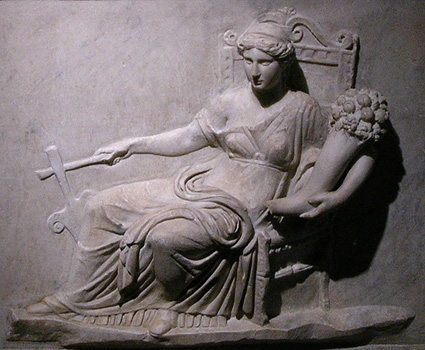
The Goddess Fortuna in the Capitoline Museum
(linked direct from website)


The above example is a marble relief depicting a chair made of bronze, several actual examples of which have been recovered from archaeological sites of the Roman world. This is a very basic form, as we know it today, of a chair. The fact that this chair is represented as being made of metal, as opposed to wood, is immaterial. There seems to have been a large quantity of metal furniture made throughout the Roman and medieval periods, and any serious discussion of medieval furniture must include non wooded furniture as well. In the museums we find many Roman examples of bronze chairs, and at least three (the "Dagobert Chair" from the 7th century, the 11th century "Kaiserstuhl" from Gosslar, and a remarkably elaborate 14th century gold and enameled Gothic style chair in Barcelona) from the Middle Ages. There also exists, in manuscript illustrations, several depictions of chairs which clearly indicate metal furniture. Even if these are the only three which I have mentioned, and there are not many others still in existence, they speak forcefully of a tradition of metal-fabricated furniture, which must have continued throughout the Middle Ages, as any type of industry needs continuous business in order to survive. In addition to chairs made of metal, there was also an ongoing practice of making objects of wood, and then covering them in gold or other metal foils, and further enhancing them with gems, crystals, and enamel.

The form which we associate today with the term 'chair', is that of one having four legs, and a back; if the front legs extend above the front of the seat and are connected by a cross member to the back, we term that an "armchair". An elaborate version of such a chair is what we usually associate with a "throne", so this will be our first form of chair; we will call it a "throne chair", though, as already stated, a throne indicates a function of a chair, not its form. When I discuss this form in greater detail, we will examine variations to this basic shape, but for now, here is one example of such a chair.


Shrine of Sainte Foy, Conques Abbey
originally 9th, century but with 10th
and 11th century alterations


This happens to be another example of a metal chair, but a piece of furniture of such form could just as easily have been made of wood or even stone, then covered with foil and other ornaments. In fact, the "Throne of Charlemagne" in Aachen, is very similar in form to this, and it would be ludicrous, given the opulence of other surviving objects associated with him, to believe that, as originally fashioned, it would not have also been ornamented in a similar manner.


As I am terming this type of chair a 'throne chair' I will make another category of objects of similar form, but less ornate in decoration, and call it a "common chair". Because we are discussing form, not function, we will find many pictures of kings, bishops, and other persons of importance, sitting in such chairs, these are, none the less, 'common chairs' in form. In the Middle Ages, these chairs usually were constructed with turned upright members, and often had turned horizontal elements as well. the complications begin to arise when we find such chairs ornamented and elaborated on, to the point of becoming 'throne chairs'; many examples of which can be found in medieval artwork. With these first two types of chair, it is often difficult to decide where to draw a line of distinction.


Isaac sends his son to hunt, in this detail from folio 25r 
of the 6th century Ashburnham Pentateuch
BNF Nouv. acq. lat 2334

In this illustration, Isaac is dispatching his son Esau on his infamous hunting expedition, as his wife, Rebecca, stands behind him; very conveniently, the artist has identified the figures in this picture. Isaac sits in a turned armchair with finials on all four uprights, but, since the back is directly in line with two of the columns, it is difficult to tell where the finials end and the columns begin. (This sort of problem was what later medieval artists attempted to avoid, as was discussed in last weeks posting.) In addition, but very difficult to discern, Esau is either siting on, or standing in front of, another turned chair or stool; one leg of which is green, the other lavender, both legs of which have splayed feet.

The study of this Pentateuch is most rewarding for anyone interested in early medieval furniture, as the illustrations are full of all sorts of examples of such. Since this book was produced at the beginning of the Middle Ages, (its exact date is disputed, as either late 6th or early 7th century) it gives us a reference to many forms of furniture which were in use at the onset of the medieval period. Nearly all the basic forms of seating, which will be discussed in this blog, are present in these early illustrations.

Another common type of seating form, found throughout history, is the stool. This type of furniture, in our modern thought, is a simple and seldom used item; it can still be found in many homes, but is usually relegated to an object for accessing places too high to reach when one stands on the floor. This type is most often constructed of wood in a very simple, unadorned, manner. By our current definition, a "stool" is a piece of seating furniture, having three or four legs (usually) and no back. Another form of this which seems to be rather modern in invention, (post medieval) is the "bar stool", which is a high legged stool, but, because of its late entry into the world, will not be discussed further.

Although we usually associate the stool with a simple, even primitive, object, this was not always the case. There are many illustrations of kings, emperors, popes, bishops and the Virgin Mary, seated on, often very lavish, stools. Because a stool form, in its broadest context, can be more simple than a chair, and we can find very ancient examples of it, people often assume it came before the chair. This is a case, however, which I believe is not possible to prove in a definitive way. In most historical contexts where we find stools present, such as Egyptian pyramids, or the ruins of Knossos, we find chairs as well.


Seated Madonna, seen from the rear.
New York Metropolitan Museum of Art
12th century


By the definition of having legs, but no back, this is a 'stool', but is certainly much more elaborate than our modern concept of such items of furniture. I chose this example because it has five legs as opposed to the usual three or four. This example also offers some idea of the ornamentation which could go into such a piece of furniture. Much of the paint has crumbled away, but there is still ample evidence of the manner in which it was decorated; further, there are some bits of a three-dimensional gesso remaining, which hint at additional ornamentation. This decoration is hard to make out clearly, but it consists of foliage and reel-and-dart mouldings in the spandrels.

A similar form of seating which is found throughout the medieval period, but no longer exists today, is what many people often mistake for a "chest". Though I have never found any discussion of this form of furniture in books or online, it is the single most common type of seat depicted in medieval artwork, (based on more than 5000 illustrations which I have, at present, already studied). Since there seems to be no name for these seats, I have termed them "plinth chairs". Just for curiosity, I typed that term into a Google Image search window, and what was revealed has nothing to do with a plinth at all, so I am not sure how one gets "plinth chair" from a doctors examination apparatus, but I will leave modern things to those interested in such.

A "plinth" is an architectural element to support a structure, or part thereof, (i.e. columns) or to support an object such as a vase or sculpture - or, in our case, a living person. A plinth is an interface between an object and the ground, and as such, this seems to be the perfect description for this type of chair. A case for the fact that these chair depictions are distinct from chests can be made from three points, The first is that in many of the depictions, the indentation to the main body, as compared to the base and the seat, make it quite impractical as a useful chest. The second point, is that in no single example of this type of furniture, have I seen a depiction of a lock, whereas, they are almost always portrayed on chests. In fact, a lock is one type of imagery which medieval artists used to designate an object as a chests. (One could argue that a person sitting on such an object would obscure the lock, so this point alone, is rather weak evidence.) The third, and best argument, comes from the fact that in many manuscripts, one can find both 'plinth chairs' and chests in the same manuscript, and sometimes even in the same illustration; in these cases, it is very easy to see that the artist was portraying two distinct types of furniture.

St Luke Composing His Gospel
BNF Lat 17968 fol 83v
first half of the 9th century

Here we see St Luke in a contemplative posture, as if pondering the gravity of what he has just written; his chair is clearly distinct from the chest which stands beside him. It is also worth pointing out that both of these pieces of furniture depict panels in their sides. Notice, also, the lock in the front, and the hasp to the lock, on the lid; symbols used to indicate a chest. The plinth chair, which may or may not be able to double as a storage device, has no indication of being anything other than a seating apparatus, in this illustration.

Another form, related to the armchair and the plinth chair, is a "box chair", This type is not found in the Ashburnham Pentateuch, but versions of it can be found in early 9th century manuscripts and possibly some of the Insular Art, of the 7th and 8th centuries, though it is often hard to tell exactly what they are portraying, due to the great abstraction of form that this art style takes on. In essence, a box chair is a plinth chair with a back, or in some cases, a back and partial sides. Two famous medieval chairs which have actually survived, are of this form, viz the 9th century,so-called, St Peter's Chair, and the 6th century Chair of Maximian. Perhaps, the already mentioned Kaisers chair of Gosslar, falls into this category as well, though its base is a solid block of stone, as opposed to a box.


Chair of Archbishop Maximianu of Ravenna
Archiepiscopal Museum, Ravenna
6th century (from Wikipedia) 

Though the 'plinth chair' is the most common seating form depicted in medieval artwork, a close competitor would be the "X chair" in its several forms. The folks over in The Netherlands, who have been doing their St Thomas Guild blog for the past four years, (and were my inspiration for starting this one) have already posted a lot of information on this type of chair and its various subcategories, they even featured a finely preserved Danish example which is over 3000 years old. Most of the depictions of these 'X chairs', from the Middle Ages, have animal head and feet terminals to the legs; some of them seem to have been very large and ornate. Other depictions of these chairs, however, are of a simple metal from, very much like many of the bronze examples recovered from the ashes of Vesuvius. 


Relief sculpture on St peter's Church, Utrecht.
c1200
Though much more common in paintings, these "X chairs"
can be found in sculpture as well.


In the artwork from all periods of the Middle Ages, we also find "benches". These pieces of furniture can take on any and all of the various forms of chairs and stools. I even have one illustration of a double length 'x chair' though I am not sure how possible such an apparatus would actually be. As I have said before, medieval illustrators were not concerned with reality, so much as a concept, and placing two or more rulers on one bench was simply a way to portray the notion of co-rulers. Some of the best examples of this concept can be found in illustrations from the Book of Revelation, in which John mentions "twenty four elders, seated on thrones, judging...", in many examples, the artist drew two long 'throne benches' each with twelve occupants. There is probably no way to know if such benches were made for any real occasion, perhaps at a tournament, or a synod of bishops, but regardless, it would obviously be possible for someone to make such a thing, should the need arise. There are a some actual late medieval benches which have survived, the earliest I know of, coming from the 12th century. One example of these benches are three individual items made of stone, and can be fiund in the 13th century Norman Castle of Gioia del Colle, in southern Italy. A second example comes from Gamla Uppsala in Sweden, this is a turned wooden bench which supposedly belonged to a bishop of the church there, and is of late 12th century construction. I swiped this image from St Thomas Guild because, right now, I cannot find my picture of another similar, even longer, bench which is in a church ambulatory in Northern Germany.


Late 12th century bench from Sweden

Of course, we can also mention the numerous surviving examples of choir stalls found throughout Europe, some of which date back the the end of the 12th century. These fixed units are no more than benches with individual dividers to separate each occupant from his neighbour. Many of these stalls have high paneled and carved backs, with baldaquins or canopies overhead, very much like those found pictured in contemporary medieval manuscripts.

Not so easily classified as the preceding forms, are other types of furniture which are rather like "none of the above", and for the use of this blog, I will term as "other seating forms" These include alternate shapes to plinth chairs, as well as chairs made from barrels or even hollowed from logs, and chairs with elaborate backs or bases. The best way to understand this category will be to wait until it is explained in its own future posting. Here is one example, however, from the British Library's Harley manuscript collection. 


St Luke Composes His Gospel
early 9th century


In this example, we find St Luke seated on some sort of barrel shaped chair with scrolled brackets supporting the drapery behind him. This chair seems to be round in diametre and bombé in form, which means that the French of the 18th century did not invent this form of furniture, though, perhaps, they did in the 9th? (sorry Encyclopedia Britannica). Although it seems to have a base to it, as a plinth chair, chest, or box would, the artist has indicated short feet on it as well. The "back" of this chair is not a back, as we understand it, nor were many of the other chairs illustrated in this period of the Middle Ages. Persons of importance have always, on ceremonial or important functions, been seated in front of ornate draperies or tapestries which are termed a "Cloth of Honour". It is the hanging apparatus for this sort of drapery that is depicted here, in what looks to our modern eyes, like a back. In many other medieval illustrations, which show this part in more detail, we see that there is no structure, save a top rail, which could support a sitter, were he to lean back against it. (This, in no way, is intended to suggest that chairs of this type could not have back, as many other illustrations clearly show they did.)

Lastly, in this group of furnishings which we are discussing, comes a piece of furniture, which is not actually a seating implement at all, but which, none the less, must be covered in a discussion of seating in the Middle Ages. This device is called a "foot rest", and was indispensable to nearly anyone sitting in a chair in the time period of our topic. Like the chairs which they accompanied, they had almost endless possibilities in form and ornamentation. The last illustration actually shows two of these, but I rather suspect that the second one was added to compensate for the fact that the evangelist's feet would not reach the first one, as the artist had positioned it. This theory is supported by examining other works which seem to be produced by the same artist, none of which have a second foot rest, and also, by its awkward relative position.

When one wishes to catagorise nearly anything, they will soon run into problems of exactly where to put some items, overlaps of multiple catagories, and items which just do not neatly fit into any single segment. The same is true for this attempt at breaking down the various types of chairs illustrated during the course of the Middle Ages. Often, life does not willingly fit into nicely packaged boxes. Our catagories of, Throne Chair, Common Chair, Stool, Plinth Chair, Box Chair, X Chair, Bench, Foot Stool, and Other Seating Forms, should cover most of what was made in the medieval world of Europe. In future postings, I will be examining each of these types in more detail. A longer term goal of mine is to actually make a chair from each of these catagories.


Videre Scire


Note to readers; Several of you have sent private emails to me, stating that you were not able to post comments to this blog. When you wish to add a comment, you must first be sure that Google has recognised that you have signed in, Even if you are already signed in to your Google, (or other supported system) you must still sign in again within the blog before you attempt to publish your comment. You accomplish this by clicking on the appropriate icon in the top right-hand corner of the comment dialog box, or by entering your email address where prompted. If you do not see your name in the "commenting as" box immediately above the comment box, your comment will not register.

Cheers