Showing posts with label medieval book covers. Show all posts

Tuesday, June 17, 2025

12th Century Style Wedding Box

A few months ago, one of my very dear clients announced that their daughter was getting married and they asked me to create a keepsake box to present as a wedding gift for the new couple. Having watched the young lady grow up over the last twenty seven years, and given all of the work that I have done for the family over those same years, I was very happy to make something that would be extra spacial for them.


Centre front detail of the wedding box


The only stipulation, other than an idea of the size, that I was given was a suggestion that it should somehow include an inscription with the surname on it. Otherwise, I had free artistic license to do anything I liked as the clients said they knew, "whatever you make will be beautiful."

I was informed that both bride and groom like "archeology", but was not given any specific culture or time period, I did know the couple would be going to Crete for their honeymoon, so my initial thought was to make something with a Minoan theme, as I too have an interest in archeology, especially as it relates to ancient advanced civilisations. However, as I began planning what I would make, I realised that I am a "mediaeval guy" and I should stick with what I know and like the best, so I landed on the 12th century and started working on something.

As with all of my furniture and boxes, this had to be completely hand made, (my own stipulation, not the clients') I chose a plank and started sawing. At this point, I had no clear idea what I would be making, yet.


Sawing by hand. (These pictures are taken from videos)

Planing the first face flat

marking the edge of the second to produce parallel faces

planing the second face

"shooting" (squaring up) the ends

Ripping the piece of timber into two halves

We now have two long sides for the box


Years ago, I did an intarsia project and had a lot of material left from that; I decided that some of that stuff would be good material to decorate the box with. That part I had decided on, even before I started cutting the timbers, but that was about as far as my planning had gone. I had also decided on the length and width of the inside of the box; the outside dimensions were determined by the timbers that I chose.

It is not well known, and some "histories of furniture" would have you believe very much otherwise, but intarsia work never left the world of furniture ornamentation during the middle ages. It was an art very much practiced by the Romans, and a couple well preserved carbonised examples in Herculaneum prove this to be true. I have seen some old photographs of a now lost (?) 7th century box which was made this way, there are illustrations of the art from 9th century manuscripts, and there is a 10th century multi-leaved wax tablet floating around somewhere, whose outer leaves are thus decorated. This brings us to the 11th and 12 centuries from which there are quite a number of surviving examples of intarsia boxes of German origin


Video stills showing the making of the centre

Cleaning up the intarsia "love knot" inserted into the fig-wood centre

The centre intarsia, complete and ready for a border


Nearly twenty years ago, we had a very harsh winter and some fig trees of the grandfather of the bride were killed by that cold. I took a piece of one of the trunks, when it was cut down, because I wanted to see what fig wood looked like. I cut it up as "oyster veneer" (Meaning veneer cut across the trunk of the tree, not with the grain) and it has been lying around my shop, ever since. The grandfather (now deceased) and granddaughter had a very close relationship, so I thought it a fitting gesture to incorporate some of his tree into her wedding box, thus I chose it to go around the "love knot" intarsia.

Once I had established the idea of the material for the box, the question was how to incorporate an inscription into the mix. Somehow, I came up with the idea of using bone, which one often finds paired with wood in mediaeval boxes. I have done several furniture restorations over the years, using bone to replace missing ivory that had been used in the pieces. I still had a couple bones in a drawer so I got one of those out, and it was of a perfect size to do a plate with their surname on it, and that was where it all started. I then had to make another plate for the initials of the couple, and then a couple more were wanted to complete a frame for the intarsia "love knot", again, something that I had made up years ago. 


Preparing to make some flat plates from bone

Cutting the bone (video still)

cutting the plate to width

Beginning the monogram

side pieces to complete the border


To be continued. 

The box is finished and has been delivered, but I wanted to keep this project private until after the fact, no pictures of it went on this blog or my Instagram page until after the wedding, because no one knew what I was doing and I wanted to keep it that way. I will post more pictures and more of the story of its making in future posts


Sunday, June 21, 2015

To Ornament or not; Part II - The cost of things

From time to time, reading books on furniture, I come across comments such as this one from Percy Macquoid's Age of Oak; "For the purpose of comparison, we give in Fig. 34 a French walnut credence of about the same date;'[1520]'being foreign, and therefore more advanced in style..."

The general idea is usually the same; that this or that craftsman was inferior to some other craftsman, or the collective artisans of another region or country. Though this idea always tries to show one work, or group of works, as superior to another, because of quality of construction, ornament, or both, perhaps we should question the possibility of other factors which might account for the varying degrees of refinement found in furniture? To be sure, there have, and always will be, more and less skilled tradesmen, but that might not be the only factor leading to one historical piece being plain and simply adorned, (or not at all) whilst another piece, from the same time period, might be much more decorative or well constructed. Did anyone consider that perhaps the factor of money might have had just a little bit of something to do with it as well?

In this post, we will examine how economic circumstances might have played a large role in the ornamentation and quality of furniture and furnishing. "Economic circumstances" can be thought of in two different aspects. The first being the economy of the region in which the artist is practicing his trade; the second would be the amount of money which a patron or client might have felt he was willing to spend on the project.


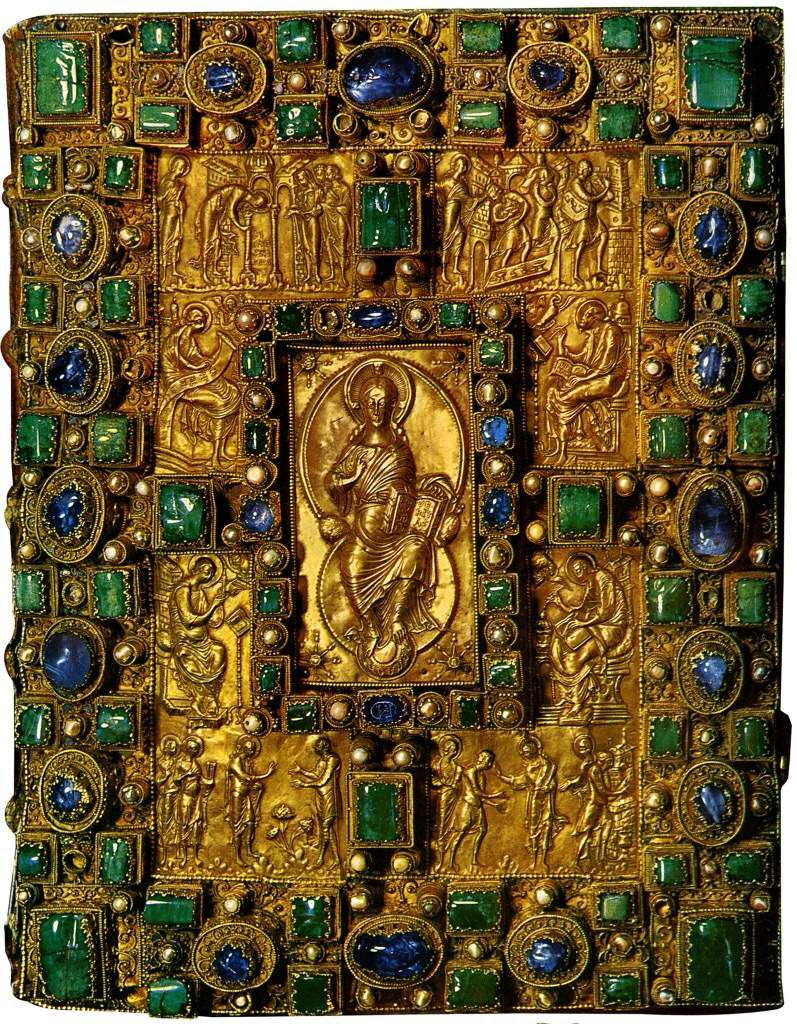
9th or 10th century Cover of a Gospel Book from Mainz
Bayerische Staatsbibliothek clm 4451

Some regions, flush with trade, industry, or natural resources, would naturally have a wealthier economy than other areas which might have primarily relied on an agrarian livelihood. I have recently been reading about the histories of Mainz and Passsau, in Germany, and how their differing circumstances shaped the outcome of those two cities. (Not a single work, and I am the one drawing a comparative connection.) Perhaps the consideration of their developments can give us some anecdotal examples of the difference a region's economy might play on the objects produced in them.


The city of Passau, from an etching ca. 1572
(Wikimedia)


Passau was apparently founded earlier both by the Celtic/Germanic tribes, and re-founded at an earlier date than that of Mainz, by the Romans. Both cities were important outposts in the Roman system of frontier fortifications and both had a strong local economy in the "Migration Period" (Völkerwanderungszeit) following the "collapse" of the Roman Empire. Both cities were governed by local kings in the 6th and 7th centuries and both served as local centres of trade and industry. Though the second never became a great city, nor did the first fade into oblivion, during the first half of the Medieval period, they did have markedly different fates.

Like so many other things these two cities held in common, both of them were invested with a "Bishop's seat" (in other words, a regional centre of ecclesiastical-political power) in the 8th century. The primary distinction which made Mainz one of the most politically powerful cities in the Holy Roman Empire, from the 9th to the 17th centuries was the fact that, unlike Passau, it was granted an archbishopric.


The city of Mainz, from an etching, ca. 1572
Now this was a beautiful city. (Global urbanization and overcrowding; look and weep for what you lost.)
(Wikimedia)

Already in the 9th century, Mainz was an immensely important centre, and in the context of my primary interest of furniture and furnishings, was involved in a highly skilled and sophisticated industry of the production of ivory panels, boxes, and other items made from that material. Because the raw material required for that trade was so dear, it is obvious that a large amount of wealth attended that city. In addition, archbishops were not generally known for their spartan lifestyles. The artisans of Mainz must have enjoyed a pool of well funded, and generous patrons, and the artworks which can be positively identified as originating there, reflect this.

On the other hand, Passau, as a more ordinary city, had a more ordinary set of clients; not much of  any particular renown came from the place before the 13th century, when it began to be known for its superior metal-works. This seems mostly to be a case of "money and power begets more of the same", and thus Mainz was a city which grew in power and prestige. By the 10th century the Archbishop of Mainz had gained the position as the most influential of the 7 Electors of the Holy Roman Emperor. (The guy in charge of the Holy Roman Empire.)

We do not know what great craftsmen of wood and other forms of furnishings might have plied their trades in the city, as their memories have all faded to dust, but it seems to be a safe bet that they would have had a similar level of skill to the book illuminators and ivory artisans, already mentioned, whose works are still known to us. In the circles of art history, you will find reference to "the School of Mainz". I have no idea if there was an actual "art school" as we would think of the term now, this phrase more broadly speaks of the artistic taste, style, and level of skill emanating from the artistic workshops of Mainz and her nearby monasteries etc. This same idea is again repeated in the loosely defined term of "School of Florence" in the context of the birth of the Renaissance art of the 13th and early 14th centuries, under the leadership of such prominent artists as Cimabue and Giotto.

I have mentioned these two cities, not because they were of any particular significance, as compared to other medieval cities of Germany, but simply because I had been reading about them, and their evolution over the course of the Middle Ages. Most histories of places do not include much at all with regard to the craftsmen and trades practiced within a city, unless it was of significant importance, or of far reaching impact. Neither of these towns fit that bill, until the 13th century when Passau began to be renowned for fine blades and weapons. Doubtless, this would have included tools for other trades as well, but since society seems always to have had an insatiable appetite for all things martial, weaponry gets most of the attention, whilst more useful tools are completely ignored. (Though many illuminated manuscripts were produced in Mainz, other cities, such as Hidesheim, Echternach, St. Gallen, and Reichenau, were actually much more renowned for their books.)

Speaking on the topic of what was more finely produced in one place, than in another; at the beginning of this article I mentioned a quotation from Percy Macquoid, an English author and antiques enthusiast. who wrote at the beginning of the 20th century. His primary focus was on English furniture, and he, like so many others of his time, had been steeped in the notion which was prevalent in his day; namely that almost everything produced before the Renaissance was backwards and primitive - especially in England. (Actually this notion persists to this day, bolstered to a large degree by the writings of Mr Macquoid and other of his contemporaries.)

One of those contemporaries was Herbert Cescinsky, who also wrote an History of English Furniture. A quotation from his book will show the prejudiced notions which he held. His treatise on furniture begins with the "middle of the 13th century", and speaking about a chest of questionable date, he states; "This type of chest persisted well beyond the fourteenth, to the early fifteenth century' [there is such a huge difference in time here] '...but here the top and uprights are scratch moulded, a sure indication of the fifteenth century. The wood here is not left rough from the saw, but is dubbed smooth, and with a plane, not the adze."

In this statement, and others in his book as well, Mr Cescinsky is assuming that any sort of moulding or working with planes could not possibly have come from before the end of the 14th century. He is basing his opinion on the general notions of his time, and by the examination of an handful of extant chests from some parish churches around England. Whilst it is true that those other 13th century chests he cites in his book are quite plain, on cannot judge the appearance of all furniture produced in an entire country over the course of 100 years (referring here to the 14th century) by examining six, or even 60 individual pieces.

Something I find quite intriguing in these two men's notions, is the obvious contrast from their prevailing views, with that of the 13th century Coronation Chair of Westminster Abbey. One would think that these two men surely knew of its existence, yet it is quite clear from its decoration, that the level of skill executed in its construction was far superior to their notions of the English cabinetmaker's trade of that time. Furthermore, there are other existing 13th century English creations, such as the choir stalls of Lincoln and Chester cathedrals which bear the same degree of skill in their craftsmanship, and demonstrate the use of planes, both for smoothing and for moulding.


1296 Coronation Chair of King Edward I
Though much damaged by seven hundred years of abuse,
this chair (with a 17th century replacement base, possibly
patterned after the original) still shows a high degree
of skill and craftsmanship. 


In Mr Macquoid's book, which begins with the end of the 15th century, as already quoted, he makes several comparisons of English and French work, with the intent of showing the English craftsmen's work to be of inferior quality to that of their French contemporaries. I would suggest that this chair gives rise to the validity of seriously questioning that notion. It would be a long and complicated undertaking, but I am quite certain that one could make a comparison of the general economy of France and England in the 14th and 15th centuries and find that that of France was in much better condition than England's. Perhaps it would be safe to assume that those persons purchasing furnishings, on average, also had less money to spend on their goods.

Many people seem to have some generally held belief that craftsmen used to work at their trade always according to their ability, making each piece as best they knew how; if a surviving piece of theirs is of poor quality, the commonly held assumption is that the maker did crude or primitive work and was incapable of producing finer quality goods. This is about as accurate, in the context of history, as it would be today. There is a much more powerful medium which, to a great degree, effects the sophistication of objects which an artisan produces; it is called money.

Just like today, people who made things in the Middle Ages, usually did not do it for altruistic purposes. In fact, today we have the concept of an hobby, in which people spend long hours making things which they never could possibly sell for anything close to the value of the time spent on them, but this idea was largely unknown in medieval times. If an artist was involved in the production of something, it was his means of earning a livelihood. Though artists were admonished to do the work to the best of their ability, as God would be the ultimate judge of their efforts, (see the introduction to Il Libro dell' Arte for an example of this) this was in the context of what they were being paid to produce. A simple box made of six pieces of timber can be well made if the pieces are properly cut to length and planed to a uniform thickness; likewise, an elaborately carved one whose work is done carelessly and with many mistakes, would be poorly executed and an example of bad craftsmanship.

I just mentioned Il Libro dell' Arte, this is a work by Cennino Cennini, and regardless of what year it was actually published, reflects the methods and materials of the time of Giotto, the master whom Cennini admired, and traced his education back to. From one of his "chapters" (usually one to five short paragraphs) on ornamenting chests, come the following entries; "In executing caskets or chests, if you want to do them royally, gesso them, and follow all the methods which you follow in working on panel, for gilding and for painting and for stamping, embellishing and for varnishing,"

"If you want to execute other caskets of less worth, size them first, and lay cloth over the cracks, and you do that with the previous ones as well. But you may just gesso these at first with the slice and brush with well-sifted ashes and the usual size. When they are gessoed and dry, smooth them down; and, if you care to, gesso them afterward with gesso sottile, if you wish. If you want to embellish them with any figures or other devices made of tin, follow this method..." Chapter CLXX

From reading his instructions on doing panels, we realise from this statement, that he is saying, for chests "of less worth" spend about half as much time with the gesso, and do not worry too much if it is not quite as smooth or finished. Then, spend less time and money on whatever decoration you decide to use on it. In other words, 'produce what you are being paid for'.


A small (413mm long) 14th century casket from the Cleveland Museum of Art.
This casket portrays exactly the techniques explained by Cennini for
the finer quality work of his time period; larger chests would have panels
painted with scenes, or figures, or both.


Consider these two 14th century Italian objects, both of them exhibit the sort of work described by Cennini in his explanation of ornamenting chests and panels. In his book, he explains two methods of making three dimensional ornaments to apply to surfaces. The first method is to make a mould and fill it with a very stiff gesso, then carefully remove it and once it is dry, using a little more gesso, adhere it to the surface. This would be the method used on the little casket pictured above. A second method was to have a mould in which one pressed or hammered tin foil into, and then attached it to the work, also with gesso. The detail below shows a tin lock plate with some ornament pressed in from the back side. Though this was probably done with a punch on a wax and brick dust cake, in a technique already in use in the 12th century, as described by Eligius, (You may read an excellent essay on working with this material here.) the end result is very similar to the method described by Cennini. The difference in the two methods is that in the second, the metal is much thinner. In the case of the pressed metal decorations, the metal would have been left exposed, or painted with a transparent colour, whereas the gesso ornaments needed additional coats of gesso and scraping followed by gilding. This would obviously require more time, and cost, and thus the object would be more expensive. Notice that Cennini is assuming that the same craftsman would be doing both sorts of work.


Detail of a chest in the Metropolitan Museum of Art.
This close up shows the reverse punched design to the lock-plate.
Additionally the metal strapping has a series of circular ornamental punch marks on
the face. When this chest was new, the metal would have been bright tin, and
the chest a brilliant blue with white and orange decorations.


It may come as a surprise to some, but even the "great masters" of art worked on things such as chests, crucifixes, and portable altars. In Il Libro dell' Arte, Cennini is giving instructions for would be artists. His primary focus is on panel painting and frescoes, but he also talks about painting banners, and painting on stone, glass, and leather. In other words, a craftsman makes his living where and how he is able. If a patron is willing to spend the money, he will produce a masterpiece, if the client has less money to spend, he will produce something more ordinary or plain. Can one not assume, then, that the same would be true for wood carvers. Just because a craftsman may have had the ability to produce an exquisitely detailed carved buffet, he may not always have been able to find someone willing to pay for one. Quite possibly, he may have spent most of his time creating pieces which some modern inconsiderate historian casually dubbed, "crude" or "inferior".


Bartolo di Fredi, scene of St Paul the Hermit
On display in the Berlin Gemäldegalerie as a "painted panel" this was once
a front panel of a chest.
There are many of these sort of panels scattered throughout the world's
museums, many of them produced by great masters, and all once belonging
to chests, cabinets, and altar pieces.


Videre Scire


Saturday, April 11, 2015

Interpreting Medieval Art; part II - What you see is NOT what you get!

In my last post on interpreting objects in medieval artwork, I introduced a chair from the 11th century. Before we get into more of what that chair might have looked like, however, I thought it would be good to further establish some truths of fundamental importance to the nature of almost all representational art of the Middle Ages. Basically, as I have said before, the original artists were not trying to show anyone what anything looked like, Even treatises on technical concepts were very basic and no one could possibly make anything functional using those illustrations as "plans", as we think of such now. All illustrations were simply meant to convey a basic idea to people who already knew what they were implying. This posting will attempt to further drive that point home.

Anyone even slightly interested in historical woodworking topics, will doubtless be familiar with the author, Joseph Moxon, and will know that even at the late date of 1680's the tools illustrated in his book are only form representational, not meant to show us exactly what a plane, workbench, or cramp (clamp for American readers) etc. looked like. I swiped a picture off of Peter Follansbee's website to show what I am referring to. (Though I also have the book which it comes from myself) Obviously, an actual workbench, and its associated tools, do not look like this, but it does give us the idea of the form which they might have had, and some clues to the type of construction utilised (mortise and tenon joints for the legs, for example) It tells us nothing about how the top was made, how the vise worked, or what type of wood would have been used in its construction, in fact, there is nothing in this drawing to even show us that it is made of wood, and only our knowledge of workbenches being made of wood inform us that this one would have been as well. The same is true of the joinery I just mentioned. People who know about woodworking will know how these parts would have been joined, but those who do not, would not. Even those of us who do, may wonder how the top was attached, as there could be several possibilities.


https://pfollansbee.wordpress.com/tag/moxon/


The concept I am trying to point out is that people in the know will understand what they are looking at, and do not need more information. People in the 17th century would know how to join the legs and the top, so there was no reason to explain it or make detailed drawings to illustrate the methods used. It is only later people, wanting to be authentic, who clamour for the details.

Even in our modern world with photographs of everything, the concept of simple schematic images to convey information has not been completely lost to us. When was the last time you saw a photo of a man or a woman on the door of the loo? Here is a sign of a duck crossing. Last time I saw ducks, they did not look like this picture, but anyone who knows about ducks and drives cars will recognise that this road sign is telling us that we should be on the look-out for ducks in the roadway.


quack, quack


Getting back to the topic of medieval artwork, which is the subject of our discussion, I constantly encounter pictures of objects which people have made, be they clothing, furniture, shoes, or housewares, in which the makers have chosen a very literal interpretation of the things they saw in the manuscripts or paintings. What I want to show here, is that we can tell by examining these illustrations, and comparing them with actual extant objects, that the miniatures and other works of art only convey form and basic information, leaving most, if not all, details of ornamentation completely out. By observing the level of ornamentational detail in an object within a picture, which we know the appearance of, we can gauge the probable degree of detail which would be appropriate for the other objects in that same illustration.


BNF Lat 323 fol 150r  850-75 AD
Notice yet another well formed desk also


Pay attention to the book which St John holds in his left hand in this manuscript. Right away, we can see that it is intended to represent an ornate book, as it has been rendered in gold, and also has rows of dots and a circle on the cover. Due to the scale of this piece, this was all the detail the artist felt was necessary for this painting.  We should ask, though, "What might a book cover actually have looked like at this time?" Fortunately, in the Bavarian State Library, can be found just such a book cover. Sadly there are not too many of these left from the time period of this manuscript but there are a couple, and this is one of them. Books written by hand were expensive and precious, their bindings reflected this; one meant for a king, or a bishop even more so.


Codex Aureus of St. Emmeram
Bayerische Staatsbibliothek
9th or 10th century


In this book cover, known as a treasure binding, we see the basic idea as expressed in the artist's dots from the last illustration. Around the border of the cover can be seen a row of gemstones, a cruciform central motif and a large central focal point.This seems to be the basic layout of all book bindings for most of the Middle Ages. Sadly, because of their obvious value, most of these bindings were destroyed for the value of their materials, I know of only three surviving objects which are contemporary with this manuscript, but each of them has the same overall format. This binding in the Bavarian Library is said to belong to the "Carolingian School" but it is some 50 to 100 years after the time of Charlemagne. As far as I know, there are no surviving covers from books which actually belonged to him, though his will states that he had a "vast quantity of books" in his "library". A few books, sans original covers of his, have come down too us. Some of these books are lavishly illustrated and show borders and frames which are also painted representations this sort of gold and jeweled ornamentation.


St. Gallen, Stiftsbibliothek, Cod. Sang. 433, zt. 44
3rd quarter of 9th century


Here is another illustration produced by a different artist, but of the same time period. Again, the illustration show us a book, but although it is even more simplified in its execution, it still gives us the impression of the same sort of cover. In fact, most illustrations of books from this period (and for several hundred years after) use this basic formula of a central lozenge and four 'teardrop' shapes at the corners. I have used the power of a photo editing program to quickly demonstrate how this basic formula compares to an actual book cover.


Lindau Gospel Cover with schematic
overlay drawing
Morgan Library
3rd quarter of 9th century


Lets look at some of the other objects in this illustration, which I believe, is a representation of a scribe giving a gospel book to Pope Gregory the Great. Even if I am wrong about who is illustrated, the man in the chair is obviously a more important person than the one giving the book. Look at their clothing and shoes; in the case of both figures, their shoes are identical, and the only distinction between the seated figure and the standing one, as far as clothing, is the stole which Gregory wears. The last time I checked, popes wore a bit fancier clothing than scribes, even if they were well paid. In this illustration, the artist is only showing us form, the rest of the details are left out, thus, a pope's shoe which undoubtedly would have had embossing, fancy stitching, gold leaf, and even jewels for ornamentation, would have had the same form as the scribes, who may have only had a little stitching or embossing on his shoes, none of which is represented here. 

Nearly every object we can find from the Middle Ages, shows us that the people at that time loved ornamentation. Even simple objects had some form of decoration. We have seen two lavishly decorated book covers, but surely not all books had such covers. Happily, there is one surviving book found in the tomb of St Cuthbert, which was produced in England in the late 7th century. Here too, though the book is very small, (palm sized) it shows a very finely wrought, decorated surface.

Nearly any book produced in the early Middle Ages was important, but as the state of books were then, this was an 'ordinary' sort of book; a personal copy of the Gospel of St John, intended for the private reading of Cuthbert. (He was not a yet "saint" when he used this book.) Yet even with its very ordinary status, it is a fine example of skill and craftsmanship. Notice the careful linking of the gilt interlace lines to the central field, the neatly done embossing to the border of the cover, and the finely formed central motif. (Someone needed to do a bit of wood carving to make a mould for this first as well.) In all, this gives a nice hint at the level of craftsmanship available even in a remote north English town in the early Middle Ages. I am sure that St Cuthbert would have had other objects, including furniture, which reflected this same level of skill and craftsmanship.


St Cuthbert's Gospel
found on Tumblr


Lets not just dwell on books, however. What other things from medieval illustrations might also help us understand the relationship between depictions and actual objects?


Valenciennes, Bibliothèque Municipale, MS 99 fol 30r
beginning of 9th century
(but in a style going back to the 7th)


This is a page from an Apocalypse book, and shows the first of the seven angels pouring out his plague onto the earth; the other six angels also stand ready with theirs.  There are many early medieval horns preserved in museums, some are made of horn or ivory, others of metal, and still others of glass as this example from the Met. All of the existing horns, however, show us that they were finely wrought objects. Perhaps this is the sort of horn which the artist illustrating this book of Revelation had in mind. 


Lombard Drinking Horn
6-8th century


Though the angel depicted in the act of pouring seems to hold a 'horn' shaped object, the other 6 angels, appear to be holding objects less 'horn-like' and more 'cone' shaped; that sort of object existed in the early Middle Ages as well. Here is a glass "cone shaped beaker" from The Cloisters in New York; it shows us yet again, a very skilfully produced item. From this object we can also make the observation that the transition from 'Roman' to 'medieval' was not a sharp or abrupt one, as this is quite similar to much Roman era glassware.


Merovingian Cone Glass
The Cloister


I have a personal preference to the first half of the Middle Ages, but many medieval enthusiasts are much more interested in the latter half of the millennium, so perhaps we should see if the same trends can be observed in late medieval artwork as well. A vast quantity of illustrations from the 12th century onward are very small, and thus extremely abstract and devoid of detail. Even when we find larger works, though, they still demonstrate the same degree, with few exceptions, of the iconic nature of objects. At every period of the Middle Ages, we find the same characteristics in the artwork; namely that there were artists of more and less skill, but by and large, regardless of the quality of their work, they show us basic forms with (usually) only suggestions of ornament and decoration.


Christine de Pizan in her Study
BNF Fr 835 fol 1r
1400-1410


In this illumination, we find several objects depicted, including a ewer, or Wasserkanne as it is known in German. This type of object existed throughout the medieval world, and illustrations of it show us the evolution of its form, as dictated by the tastes in fashion. We can see this played out by comparing depictions of them with actual objects in museums and private collections. This illustration is from the beginning of the 15th century and shows us that by this time, the neck was tending to become more elongated and the top to have a more pronounced dome shape than in the preceding century. (A trend which continued into the 17th century and can be found in many Dutch Still Life works.) In this particular illustration, along with showing us the general form that the artist had in mind for the object, there is also the suggestion of gold ornamentation which shows us this is not a plain or simple object.


Jasper and gold ewer
15th century


This is not exactly the shape of the ewer pictured, as it has a shorter neck, but it shows a level of decoration to such objects which one will never find in an illuminated manuscript. Just as with the shoes in one of the earlier examples we saw, it was the shape or form of an object which was portrayed, and not its level of ornamentation. Here below, are two more 15th century ewers, much more simple than the above illustrated one. The key to determining which one would be appropriate to the artwork in question, is to consider for whom the object is intended. If the object is shown at the table of a king and queen, then probably it would be more like the above example, if not even more elaborate, (last time I checked, Kings had a marked preference for lavish objects) If the object was intended for a merchant or minor lord, it is much more likely that his object would be as those depicted below. Even the farmer's ewer would have the same basic shape, it would just be made of clay or tin. In the case of the above illustration, Christine de Pizan spent her life in the court of at least three dukes and King Charles VI of France, so it would be safe to assume that her surroundings would have tended toward the sumptuous.


Brass ewers from National Museum of  Nürnberg
15th century
(Messing means brass in German)


I could not find an example of a 15th century ewer made of a silver metal with gold inlay, except for Middle Eastern objects, (many of which would have been imported to Europe, however) but inlaying one type of metal into another is an ancient technique and was used throughout the Middle Ages in Europe as well. Here is a picture of that type of work, used in armour. I am not the least bit interested in war and military objects, but can appreciate the skill and craftsmanship that went into these suits of armour. This is doubtless the type of work which the 15th century illuminator had in mind when making that representation of a ewer.


Late medieval armour, found on a Pinterest
posting
(click image to see in better detail)


In the same early 15th century illustration, we see Christine sitting in a barrel backed chair, and just as with the ewer, this object only shows us the most fundamental representation of its basic form. There are a couple such objects in the Met and the Cloisters, in New York, Daniel Diehl featured one in his book on constructing medieval furniture, here is another, in the Met collection. but not on display.


15th century Barrel backed chair


As I said, the 15th century is way too modern for me, but I saved the following illustration several years ago because it so perfectly demonstrates this point which I have come to realise. In this miniature, we see several figures before an altar; on the sides of the altar are hanging curtains and at the back is a gold panel. The curtains are depicted with tassels and gold ornament, so surely this is a more realistic depiction, right? Wrong.

The panel at the back, is an altarpiece, which, in the Middle Ages, was the focal point of the altar. On it would be depicted one or more religious scenes, a depiction of the Crucifixion, or a Madonna and Child. (This is an over simplification; entire volumes have been written on medieval altarpieces.) It shows us a basic, North European form of an altarpiece from the late Middle Ages, Objects such as the Werl Altar and the Miraflores Altar have this basic form as well, but perhaps this one is not such an elaborate example as those. 


BL Royal MS 15 D III fol 82v
1st quarter 15th century


Even though this illustration gives us the impression of realism with the details to the hangings, and some on the clothing, there is very little further decoration to anything in the illumination, Since we know that an altarpiece, by purpose of function, must have had some sort of scene painted on it, then we know that the artist has left out a lot of detail in this picture as well. Please observe that there is absolutely nothing painted on the altarpiece.


Stadtpfarrskirche Deichsler altar,
Death of Mary
c1420


I have chosen a rather simple altarpiece here, because I am in no way trying to suggest that all objects were ornamented to the taste of emperors. This is a simple altar from a small church in an out-of-the-way town. Large churches with larger budgets would have much more elaborate altarpieces to match their status and those of its wealthy parishioners. Many illustrations of the 14th and 15th century however, simply show a blank panel as in the above illustration when they intend to show an altar.

In addition to the altarpiece panel, above the altar, the altar itself would also have been ornamented in some way. Elaborate altars were covered in gold, gems, enamel plaques and so forth. Slightly less expensive ones had gilded metals formed in low relief embossing; the next step down would have been carved and painted relief, and the lowest level would have been painted panels such as this one from Norway. (I wrote an entire paper on this sort 12th to 14th century painted altar frontal; examples of which can be found throughout Europe from Norway to Spain, and all points in-between.)


Painted wooden altar Frontal from Norway.
14th century


Such altars were built of wood and had paneled sides with additional wood base and top moulding in the form shown in the above miniature. In principle, they were cabinets, and in fact, the earliest examples (4th -10th centuries) had a door or opening in the front. Their construction was of timbers joined and glued together, then covered with gesso and painted. Examples of these altar panels can be found in such diverse places as Bergen Norway, Barcelona Spain, Essen Germany, The Met in New York, and in the Walters in Baltimore Maryland. As I said, these were usually of the simplest sort of altars, found in small churches, more ornate altars such as the following one  were common in larger churches and minor cathedrals. This altar would have doubtlessly been painted just as the panel above, the difference being that this one has more embellishment in form along with its sculpted figures.


Altar in Terragona, Spain

Notice the similarity of the form of this altar to that in the manuscript illumination. (One difference is that the base of this example is not as heavy, however.)

Finally, what about the hanging draperies? As I already pointed out, they seem to have some detail depicted in them, but again, this is only representational. Here is a sample of a late 14th century blue and gold brocade fabric, which I believe would be something along the lines of what is represented here.


14th century brocade
Cooper Hewitt Museum, New York


Yet again we touch on another point that I keep repeating, which is one of personal taste of the artist. This artist seems to have a fondness for textile designs, (as do I) so he spent more time on this aspect of his work than any other; nonetheless, as previously stated, it is still only representational. In this manuscript he had neither the time nor the dimensional space to allow him adequate justice to the fabric; he did give it a nice go though, enhancing his artwork in the process.

Next time you look at illustrations in a medieval manuscript, painting, or even a relief sculpture, try identifying objects which you can find or have seen in museums, then compare those objects to the detail of the furnishings in the same illustrations. You may be surprised at the possibilities of ornament this concept presents.


Videre Scire


Note to readers; Several of you have sent private emails to me, stating that you were not able to post comments to this blog. When you wish to add a comment, you must first be sure that Google has recognised that you have signed in, Even if you are already signed in to your Google, (or other supported system) you must still sign in again within the blog before you attempt to publish your comment. You accomplish this by clicking on the appropriate icon in the top right-hand corner of the comment dialog box, or by entering your email address where prompted. If you do not see your name in the "commenting as" box immediately above the comment box, your comment will not register.

Cheers