Sunday, November 8, 2015

Furniture in the Salerno Ivories

Whenever I have free time, I usually spend it doing research on some aspect of the Middle Ages; this mostly falls into the more specific topic of furniture and furnishings of that time period. I study by examining pictures, reading books, and occasionally going to museums. (I would love to go more often, but time and budget affect that possibility considerably.

In preparing my recent post on the topic of stools in the Middle Ages, I came across a picture of a stool depicted in an 11th century ivory plaque from Salerno. I was intrigued by this picture, so I did a bit of investigation and found a book written on these ivories, and their history and cultural context, as understood by Robert Bergman, after he had conducted several years of research and study on them. In fact, the book I bought, The Salerno Ivories, was an outgrowth of his thesis on the topic.

In this posting, I want to examine the furniture depicted in these fascinating little ivory panels; in a future post I will compare these depictions with other artwork and actual objects which I believe are of the type depicted herein. I took all the pictures from my book, and have mostly only shown the furniture; should you want to see the rest of the ivories, I suggest you buy the book, as I did.


A throne chair and a foot stool


The furniture type which is most frequently depicted is the throne chair, for more of which, see this article. There are no two chairs depicted alike, even if the same person is portrayed sitting on them (which is only the case with King Herod).

Adoration of the Magi; another throne chair
and its surrounding baldachin 

King Herod, from the Massacre of the Innocents

King Herod again, this time visited by the
Magi. Notice the differences in this throne.


There are also, featured in one of the panels, a stool, a bed and a small table. In a previous post I pointed out, and will do so again here, that the bed is not a large platform supported by four spindly legs in its centre, as a literal interpretation of this picture might suggest. The artist was not concerned with depicting things as we see them, but was only interested in compositional harmony and rhythm. He had an interest in showing the turned legs for the bed, but had he carved the scene in a more realistic manner, the legs would be almost completely concealed by the seated figures, besides the fact that he seems to have wished to use the four upright legs as part of the vertical elements of his layout. 

Here is the original picture that sparked my interest in this topic


Another type of seating which has several representations is the plinth chair, which you can read more about here.


In the scene of Pentecost, the disciples are depicted either sitting on plinth
chairs or one long 'plinth bench', the end of which is portrayed on the
right of the plaque. Each figure has his own foot rest.

Three more plinth chairs and a round table
(my apologies for the sideways picture, sometimes
Google does this and I cannot figure out how to
correct it.)


Several other pieces of furniture depicted in the ivories are beds. I have shown four here, and there are actually a couple more in the series, but the details are not clear enough to be worth including them here.

The healed paralytic carrying away his bed

Noah asleep in his bed, after having gotten drunk.

Here is an example of medieval artists not being overly concerned with the details of the story whilst carrying out their creations. In the story of Noah, he was found naked and drunk, but here he is clearly already clothed before his son drapes the cloak over him. Medieval artwork is almost never to be interpreted as accurate depictions of anything, even if it may offer some visual clues.

Another(again, sideways pictured) bed, This one with decorative
turned legs and flared feet
Compare the detail of the doors in this picture with those in the above
picture of King Herod Visited by the Magi

St Joseph dreaming in a bed with bobbin and reel turned sides


And so that is nearly all the panels which have any meaningful depictions of furniture in them, but I want to put one of these pictures here a second time, in case you did not catch the other piece of furniture in it the first time.


A bottle of wine in a cabinet

Here is depicted a small bedside cabinet, with Noah's wine flagon inside. I believe it is intended as a cabinet because of how it is depicted, but I am also aware of a series of Old Testament fresco illustrations in a church in Italy which have similar cabinets beside Abraham's bed; thus giving me additional reason to believe what is pictured here is a cabinet. In one of those paintings, the doors of the cabinet are shown ajar. When I do the second half of this blog topic, I will share that picture for your own comparison.


I have often spoken about the level of detail depicted in the objects portrayed in artwork, as compared to actual decorations of objects, and the fact that artwork almost never shows the true extent of actual ornamentation. No better example of my point can be found than in the following set of pictures of ornamental fragments which originally framed these ivory plaques that we have just examined.

It is the theory of Robert Bergman, who spent several years studying these ivories, that these panels were originally part of a set of doors. As such, these ornamental bands would have formed the framework to the door panels. By looking at these decorative strips, we can get a better idea of the ornament which could have been used to decorate the sides of beds and chairs, or the legs of tables and cabinets. The remains of at least three medieval chairs, all older than these 11th century ivories, still exist, and all of them have the same degree of carved ornamentation to their structural elements. All of the decorations in the portrayed furniture are merely 'X's', zick-zacks, hatching, and dots, but this is due to the small scale of the carving. All of these ivory panels are only 90-120mm wide and to depict any accurate detail of a piece of furniture which is in an area of only 10 or 15mm would be nearly impossible, as well as being pointless. The people for whom these panels were made, already knew what beds, stools, chairs, cabinets, and tables looked like; it is only us, some 1000 years later who clamour for more information.


Several sections of ornamental carving which belong to this set of ivories


Videre Scire

Sunday, November 1, 2015

Carved Moulding, Part II

I seem to keep doing the same thing of forgetting to put the memory card back into the camera, over and over, which is making me nuts. This time I did it with an even more spectacular twist. I attended a woodworking shop with Peter Follansbee at the Marc Adams School of Woodworking (a fun place that turned out to be) and discovered, on day four, that all the pictures which had been taken at the workshop, the pictures of my carving of the moulding from the week before I left, and the pictures I took when I delivered the table just before I left, were all figments of my imagination, because the card had not been in the camera for two weeks. To top it off, when I left the workshop, I forgot the camera, and had to have it shipped to me this past week. Thus, there has not been much to post on this blog.

The staff at Marc Adams' were very kind and they took care of getting the camera to Fedex so it could be shipped. I now have it back, and can show the few pictures I did manage to get of the carved moulding project. This is what I have been working very intensely on for the past few weeks, (with the interim break for the workshop) so have been extremely busy. This past week I have been doing a lot of installation on the job.
One corner done and its twin in the works

I will post some more pictures of this project once some parts of the installed moulding are finished so people can actually see what it is I am doing with these.

Top half of the upper corners, the lower half of these must be carved from
pieces of timber that have the grain running the other way

Upper crest carving. The larger panels will use this central motif, but will
have additional carvings on both sides to make the overall design longer

I am always advocating using hand tools, but in some cases, where the use of machines would not affect the outcome of the final product, (for example, if I buy timber from the sawmill, it has been cut by machines, but it is rough and must still be worked with a plane to create furniture) I sometimes use machinery. This was the case for re-sawing the timbers which I used to split the plank for cutting out the carved sections. The band saw I used however, is not large enough, and therefore I had no choice but to do this piece by hand; good thing I know how!

Sunday, October 18, 2015

The (Long and complex) Medieval History of the Chair - part IV, Stools or Forms

This discussion in the ongoing series of medieval seating objects could potentially get very complicated if I were to attempt to address all the variations in form, material, and construction of the types of stools found depicted in the artwork, and the few actual surviving examples. I am therefore going to go over the topic with a rather broad brush of generalisations, and leave the minutia for potential future posts.

Stools are often referred to in old English as both "stoole" and "form". I am curious to know if it was called a 'form' because sitting in one would doubtless help one maintain a good 'form' of seating posture, as it would be hard to slouch whilst sitting on one, but I have not found any definitive information to support that notion. The doctor has further confused the meaning of "stool", because when he asks me for a sample, he does not expect me to bring him back a piece of furniture; though again, that must originate from the fact that there was once a "close stool", which was a chair with a pot in the seat...


A stool and other furniture depicted in the late 7th century Codex Amiatinus

In a previous post, we already discussed plinth chairs; these are not stools, even though modern readers might think of them as such. In defining a stool, we are using, here, the definition of a form of seating with a seat and an open base, as in, not a box or other solid, enclosed structure underneath. Generally, if it is not at least partially open beneath the seating surface, we will not be classifying it as a stool.

As with other types of furniture, I like to give a bit of pre-medieval history on the topic so one can see where the medieval pieces fit into the long evolution, and also to show how styles may have, (or not) changed. With that in mind, below are three examples from some of the ancient civilizations that influenced and affected the Roman and subsequent medieval European furniture.


13th century BC Stool from the Cairo Museum
(picture found on a Google image search)


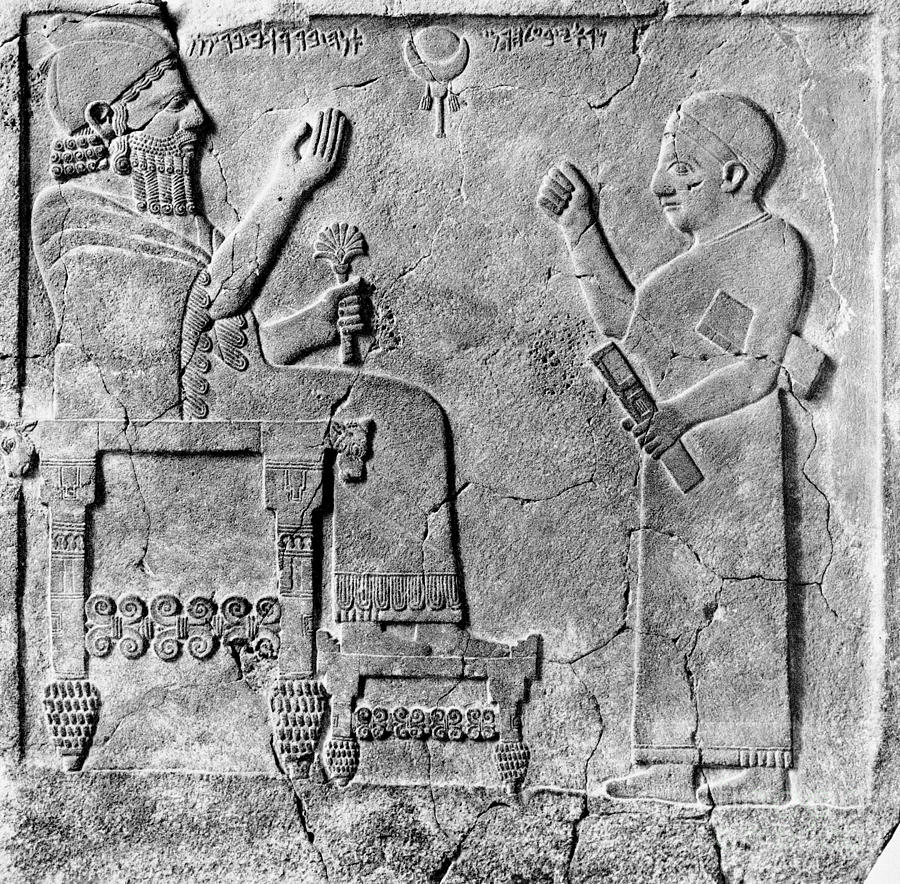
9th century Hittite sculpture depicting a king seated on a stool
(picture found on a Google image search)


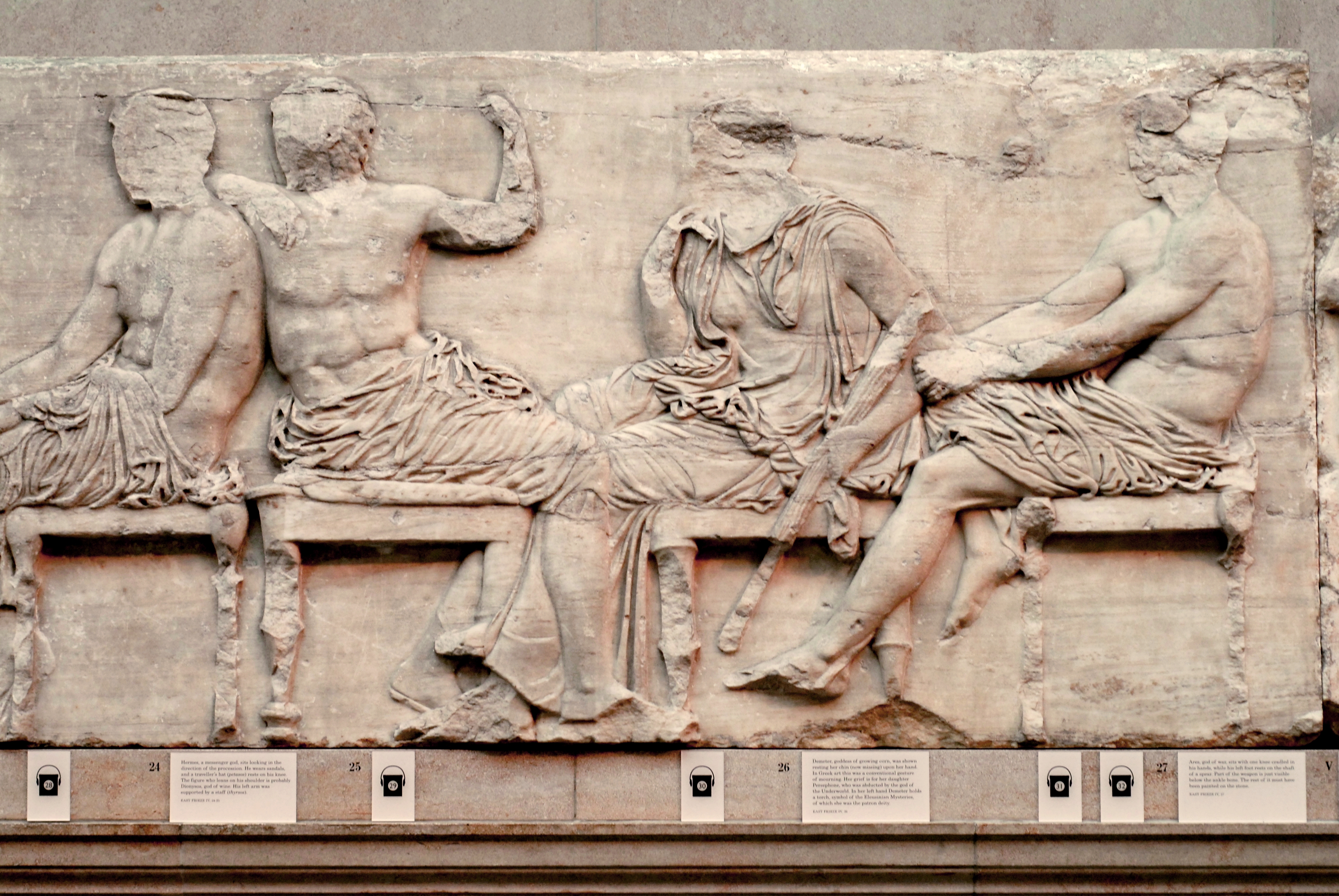
Portion of the Acropolis freeze from Athens; 4th century BC showing
four figures seated on stools
(From Wikipedia)

The Illustration at the beginning of this post featured a stool from almost the very onset of the Middle Ages, and in construction details, is not unlike the Hittite example which was already 2,000 years old at the time that the manuscript from which it comes from was made.

All of these stools fall into the category of four legged stools, but there was also another type, which was a folding "X" type. This design too, has a very ancient pedigree, and examples are found in Egyptian, Minoan, and Greek art. In addition, we have many examples of bronze Roman era stools of this type. 

These folding stools could be constructed of wood or metal, and were found throughout Northern Africa, the Middle East, and all parts of Europe. There have even been several BC era wooden examples recovered from graves and peat-bogs of northern Europe. I will not get into more details on this topic because the St Thomas Guild blog has already covered this form in great detail. You can read more about the medieval varieties on their blog. I will add this one example, however, from a 9th century manuscript, because they did not discuss metal varieties of this chair, several examples of which also exist.


BNF Lat. 17968 fol 125v; depiction of a folding iron stool from the
9th century

Having gotten that bit out of the way, there is still a huge variety in the style, methods of construction, and level of ornamentation of the fixed leg stools. It would be impossible to give an exhaustive synopsis of even all the known examples of depictions covering an entire continent and a thousand years of history, but even if we did, that would only be a fraction of what was actually produced, as so much has been lost to the ravages of time.

When one considers history which is hundreds or thousands of years old, he must first accept that whatever he gleans in information is a pale reflection, at best, of the vivacity and variety of actual life in those times. A word, a phrase, an illustration, all give us tantalising hints, but hints are all they are, and must be regarded in that light.

Those hints tell us that there were three four and even five legged stools. There were stools with carved and sculpted ornamentation as well as others which were of the turned variety. Still others were constructed of flat timbers which could be left plain in form, or decorated by shaping and or carving. As in all other types of furniture, peasants and poor people would have simpler versions than their financially more fortunate compatriots. Since medieval artwork is almost always primarily concerned with the general shape of an object, not its exact appearance, this is not always readily discernible to the modern viewer of such artworks.

Below are some examples of various stools taken from different periods of medieval history, but are in no way intended to suggest that any particular design was circumscribed to that time period. I have one illustration for each of the centuries comprising the millennium, known to us as the Middle Ages. I have shown a variety of styles of construction as well as a wide range in ornament, detail and material. (the 7th century is represented by the first illustration in this blog-post)


I have to cheat a bit for the 6th century,
This is a reproductionof a stool found in one of the many
 Alamani Graves in the Oberflacht region. I recently did
 a post on other furniture found in this region,
also from the 6th century.


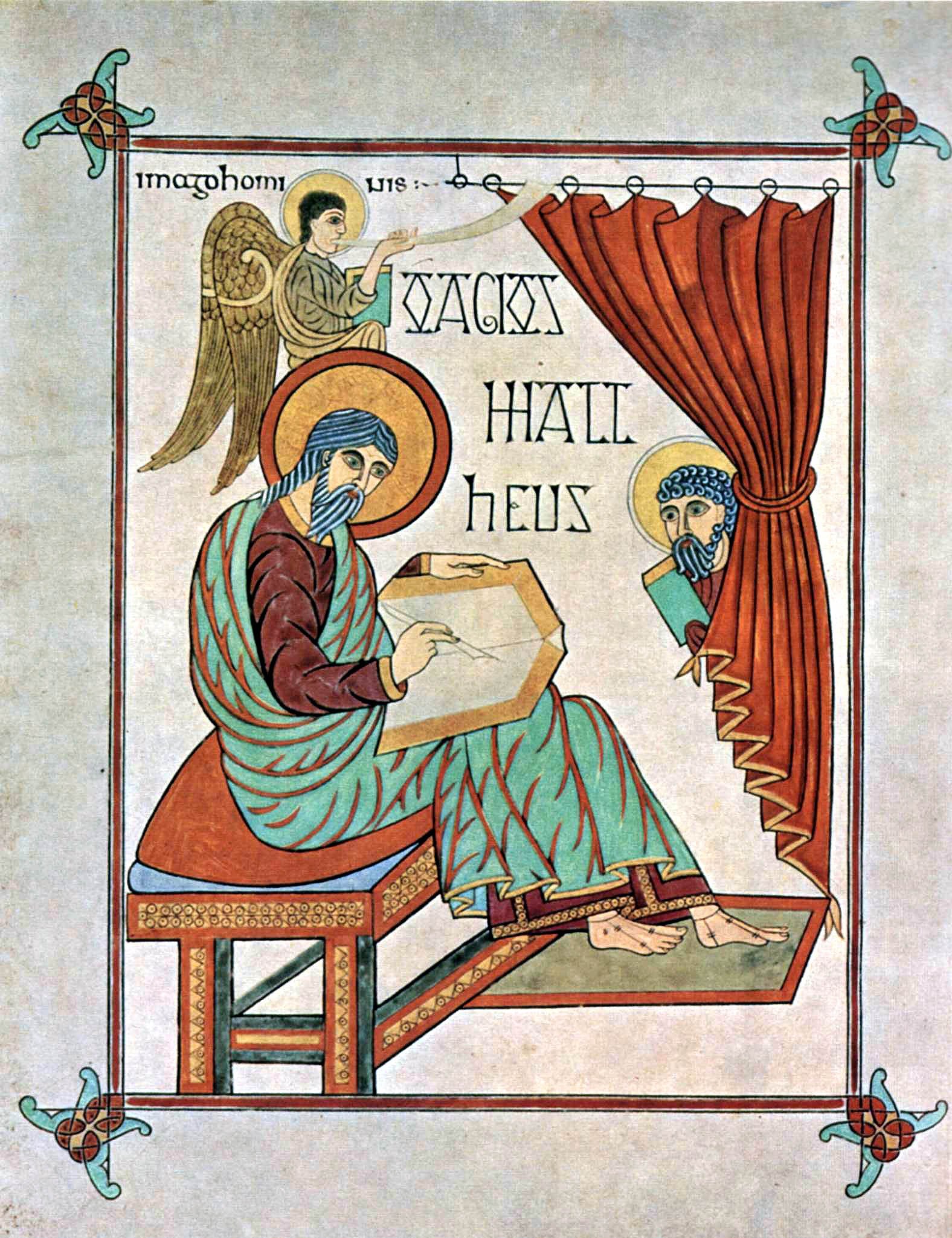
St Mathew from the 9th century Lindisfarne Gospel;
Mathew is seated on a wooden stool decorated with carved
ivory panels. (at least that is how I interpret this)


From an astronomy manuscript in the Bavarian State Library
(BSB clm 210 fol 118r) produced in the year 818
This shows a turned stool with legs which extend above the seat and have
knob type finials.


BNF Lat 6, fol 5r 10th century


From the Bibliotheque National de France, comes this small illustration from a 10th century Bible. This is a scene from the story of the life of Samuel; in this scene, the Prophet Eli has just been informed of the wicked acts committed by his two sons, Hophni and Phineus. In shock, the prophet falls backwards off of his chair, here depicted as a seat with legs fit from the underside, perhaps in a through tenon joint, like those found in many 16th and 17th century English stools, but also depicted in 14th, 15th, and 16th century artwork.


Nativity scene
Detail of one of the Salerno Ivories from ca 1080


Here is another turned four legged stool, but notice the degree of ornament suggested in this example. It seems to have a square terminal above the turning where it joins with the seat. Something I would like to point out in this illustration is the way the bed was depicted. The artist wished to show the turned posts for the bed corners, but had he put them where they belonged, from a realistic point of view, they would have been obscured by the bed itself and the figures, thus he chose to depict them seemingly propping it up from underneath, stool fashion. This is a classic example of why we cannot take medieval illustrations at face value; they are simply conveying some information, but are not "photographic depictions". Notice also the little tripod table.

12th century relief with Madonna and Child


I could be wrong, but I believe this is in the Louvre, there is a similar one in the V&A, but the stool in that panel has round legs whilst the panel itself is rectangular. In both cases, the seat seems to be constructed of very massive timbers with a lot of carving. I would expect these to be made in a way much like the still existing 12th and 13th century choir stalls; very thick, solid timber.


Another Madonna and Child, this one from the
13th century

Remember the 9th century stool with knob finials? This is a 13th century version of the same basic idea. I think this is from the Met in New York, but again, I am not 100% certain.


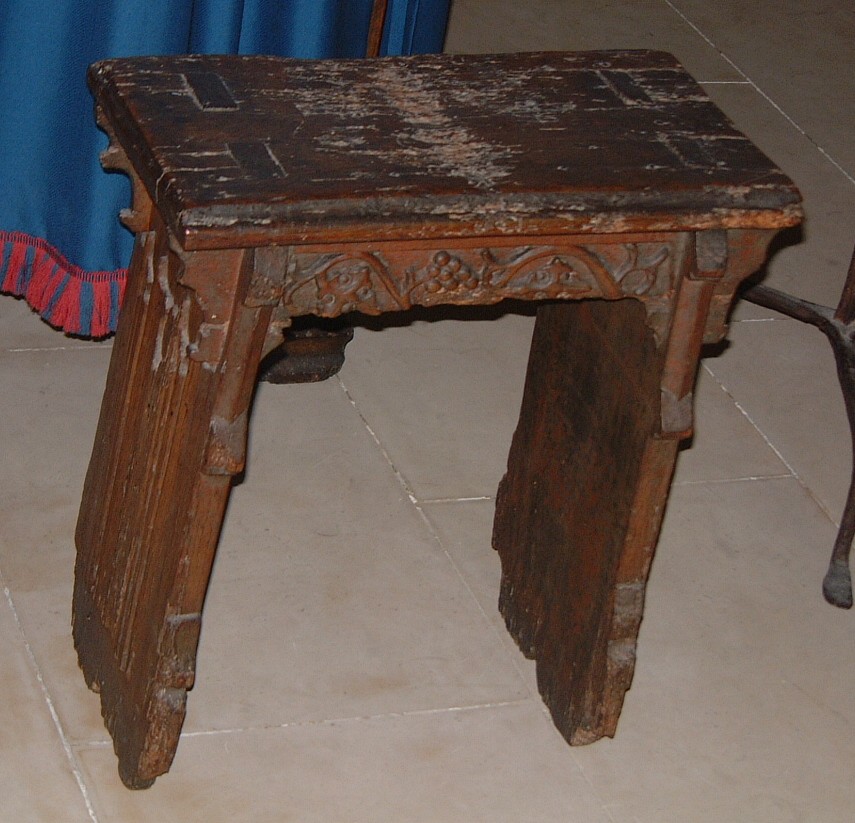
Late 14th century Stool "from a Museum in Paris"
Part of the stretcher and its carving is missing.
(picture found on a Google image search)


b
St Luke. BL Yates Thompson MS 4 fol 14r ca 1460

Notice the similarity of this drawing and the actual example from about 100 years earlier pictured above.

Furniture obviously evolved and changed over time, but some of the basic fundamental forms persisted for centuries, even millennia, as with the 'x' stool and the three corner stool. Often these forms are obscured by the various decorations that did change with fashion and taste over the centuries, if you examine them from a construction standpoint, though, they remain much the same. It is too bad there are not more pattern books preserved from the Middle Ages, as they would help us a lot in knowing how artists and craftsmen went about ornamenting their wares. Without such knowledge all we can do is study other decorative objects and guess.

Hopefully this post gives some idea of the vast possibilities that exist for this type of furniture and shows that it was something much more than just a simple plank or turned object usually depicted as "medieval" stools. (Just try doing a google image search for "medieval stool" and see how many of the examples I have given here are represented.)


Videre Scire


Sunday, October 11, 2015

Thoughts on "Traditional" woodworking

This blog was supposed to feature a story and pictures of my Show in Waterford Virginia, but there was a threat of a hurricane and thus a "state of emergency" was declared; therefor the show was cancelled. Very disappointing, but what can you do?

Right; moving on...

Yesterday I read Peter Follansbee's blog, in which he began a discussion of the current state of "traditional" woodworking as it is in the world today. You can read all about it here. The main point (as I understand it) is the lack of a traditional foundation for most modern woodworkers, and the attempts to revive old skills without it.


Peter Follansbee at work, doing his part to keep alive the traditional methods


As the word, tradition, denotes, this would be something that was handed down from generation to generation so that the work would grow and change, adapting with the times in a very organic way. Peter has suggested, and I concur, that for the most part, this tradition has been "broken". Now, most people who are attempting, or successfully practicing, these "traditional" skills, are coming at it without any prior knowledge or personal experience in these crafts. After reading his blog, I thought to add my comments to the matter, but then realised I had more than just a quick comment to add, and besides, I have my own blog page from which to express myself.

As I already stated, I agree with Mr Follansbee, and his view on the matter, Like him, I also am attempting to revive and keep in motion those methods, long discarded by most modern people who are hell bent on the latest everything, as outmoded, old fashioned, and too time consuming. I find it interesting that in other parts of the world, where I have traveled extensively, and have met craftsmen working in very primitive conditions with only the most rudimentary tools, that they think I must be out of my mind to want to forego the use of machines which are all around me, and revert to the mostly discarded methods of earlier generations.

For these people, and for most in Europe and America, getting the job done as quickly as possible is the primary goal. In a world where one has to earn an income to stay alive, this makes good sense, but it also causes the artist to lose out on the joy of actually doing the job. Is your goal the journey, or the destination? For most people, myself included, getting the job done brings immense satisfaction, and a sense of accomplishment, but for me, the actual act of doing the work can often be more rewarding and enjoyable than the satisfaction that comes with its completion. Once the task is done, one has to forget about it and move on to what is next. When I am doing something by hand, the process takes longer and gives me a chance to get to know the piece I am creating. It becomes an extension of myself, and I have a chance to infuse a bit of my soul into it. I cannot speak for others, but for me, I do not have this same connection with pieces I made with a machine. They were simply a product to give in exchange for some income, not much more.


Tradition is still very much alive in the Philippines and
the things they create every day with only the simplest of
tools are amazing


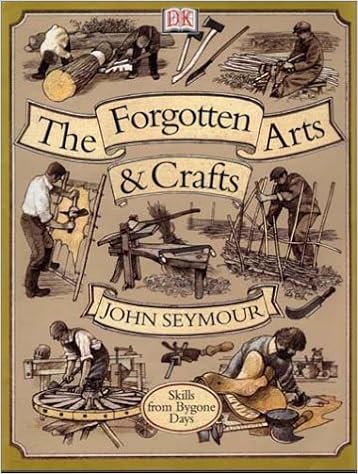
It does not feel like it could have already been more than 60 years ago, but back in the 1950's John Seymour, traveled about his native UK, and other places in the world, documenting the, at-that-time, nearly vanished traditional craftsmen who were still carrying on the actual tradition of their crafts. The book is a fascinating read, and though it was not an inspiration to me, because I had already embarked on my journey before I discovered the book, it was something to give me resolve to continue in the path that I was choosing to follow. I noticed that all the people featured in the book were either old, or ancient, and thus, when I read it in the 90's, were all, it is fairly safe to say, gone to wherever we go, when we go. This book helped to firm up my belief that someone must take up the tools of the forefathers and continue in their traditions, because it was worth preserving the methods which they used to create the objects of their world.


Originally published in the late 50's and still a good read,
this book covers much of what "traditional crafts"
really means.


When we live in a world where most people think that vegetables, eggs, and meat come from "the supermarket", and everything has a flaming "ap" to make it work, I feel it is important for people to see the actual skills that went into creating the things that our ancestors had all around them. It is also important to remind people that every single new-fangled gadget that they have in their possession is only there because someone long ago, first learned to use a stick and a stone to make something finer and more precise.

Near to where I currently reside, there is a canal that was built in the early 1800's. Whenever I go there for a visit, and see all the blocks of stone cut and fit so perfectly, I cannot help thinking, as they slowly erode away,  that every single one of them was cut by a man and moved into position by other men and animals. No lorries, cranes, or hydraulic lifts, just skill, muscle, and ingenuity. I wonder, as I am thinking these thoughts, if anyone else ever thinks of such a thing, and wish I had a way to make them aware of it. I think it makes us better people when we are connected to out past and aware of skill and craft that was involved in getting us to the point where we are now.


Does anyone ever consider that it was manual labour which went into cutting,
dressing, and setting these stones which have been here for nearly two centuries?

I know that it is (lamentably) impossible to return to a life of earlier times, but at the same time, it would be even more lamentable to toss out all the old traditions simply because we have ways of getting more work done faster. I also think I am justified in my belief, when I consider the fact that in the days with very few machines, people produced far superior works of beauty and craftsmanship than what they do now with all the modern things which are meant to speed things up and make life "simpler". I know there are modern craftsmen who make fine things with their machines and power tools, and have no intention of disparaging anyone who works honestly to earn his bread, but I am quite certain that there is none among them, who can produce anything close to the level of refinement that went into some of the finest objects made for the crowns and courts of Europe, all with hand-tools.

I too, began my career as a furniture maker using power tools and machinery. In fact, the first time I decided to get a hand plane and use it, I worked with it until it could not cut butter because I was so afraid of trying to sharpen it. I had no one to teach me anything about how to use hand tools, so I had to learn by trial and error. It would have been wonderful if I had had a teacher, but I was determined to learn, regardless. My first reason for going in this direction was simply because I love antiques, and had a realisation that most of their beauty came from the subtle irregularities caused from working the materials by hand. I decided the best way to make something look more like and antique was to fashion it with the same methods as had been used in the original. Along the way, I came to realise there was a satisfaction from, and a connection to, my work which I had not previously felt. It was as if my soul had finally been reconnected to its tradition.


The very first thing I ever built using hand tools, back in 1997


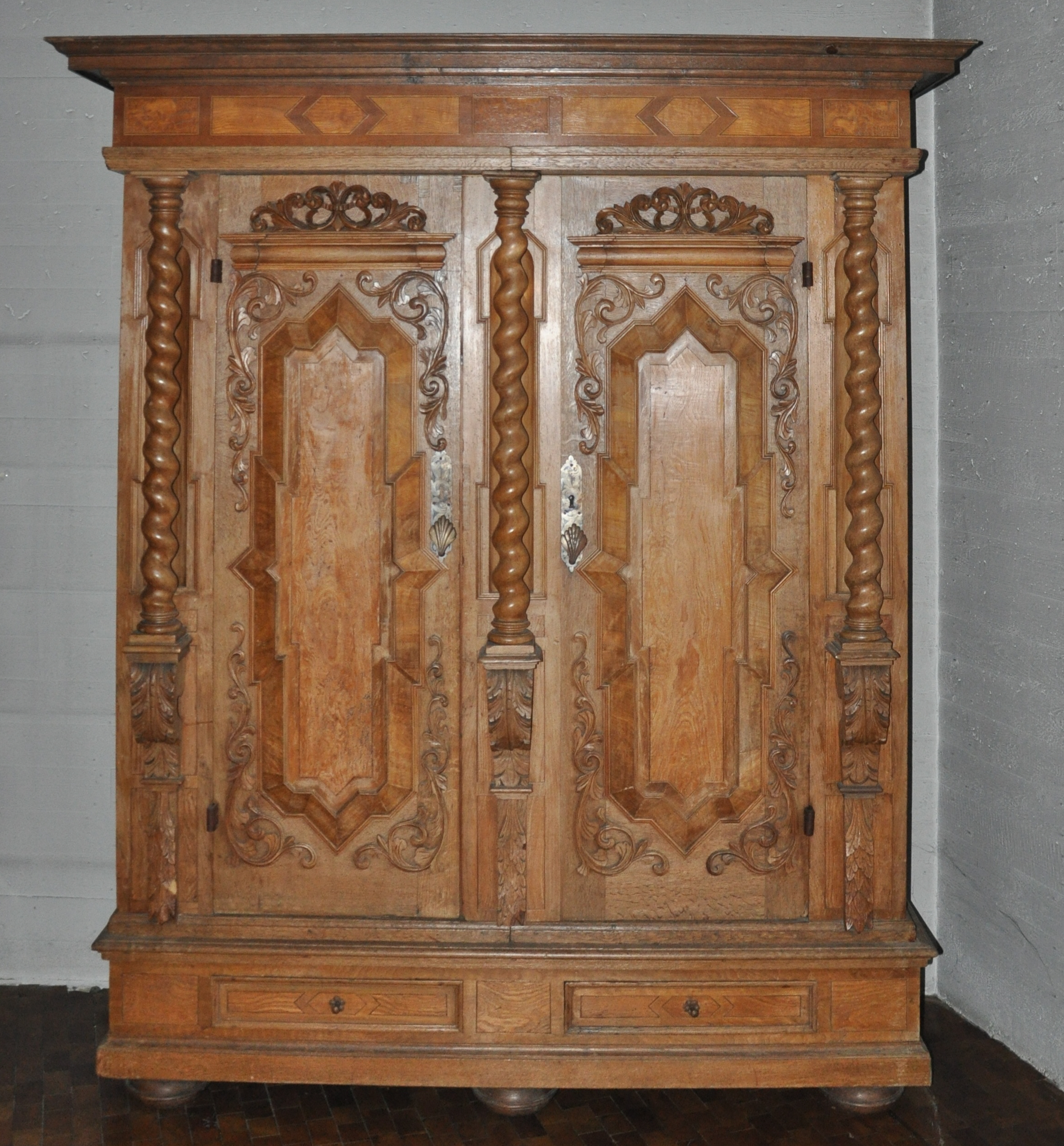
My journey into traditional woodworking was a very long and slow one. No one in my family for as many generations as I know of, practiced any sort of craft, with the exception of a grandmother who was an amateur "Sunday painter". I did, however, frequently spend time in the workshop of Herr Pfeuffer, who was in charge of all the maintenance of my childhood home and its surrounding buildings. The one tool in the workshop which he allowed me to use was a hand-saw, and I loved to cut anything I could get my hands on with it. He never taught me the correct way to use it, but that did not stop me learning. I also (without his permission) got an axe and went around chopping small trees and trying to make them into square timbers, but I do not think my juvenile attention span ever saw a single one to completion.


A typical Schrank like those which I grew up with. This is not a picture
from my home, it came from Wikipedia, but is typical of many of the ones
found in most rooms of my childhood home.


Everything changed when I was 14 and we moved into a brand new house in a small village just outside of Schweinfurt. Up until that time, I had grown up with antiques all around me. These objects were to me "normal" and all the new things that came with the new house in the town were alien to me. I believe it was then that the seed of my career as a traditional woodworker was planted. From that time on, I spent my time reading books, drawing, and dreaming about things related to the past. It was as if my soul had a connection with all the dust of history in our centuries old home, and it had been ripped free from its roots and was seeking a way back. I think part of having a sense of tradition comes with being surrounded by things that are older than we are. It is no wonder that modern kids, living with five minute product life-spans, seldom value anything "old".


Again, this was not the exact piece in my new room, but
I found this on E Bay,and it looks almost exactly like
the new soulless furniture I had to live with once we moved

On the other hand, perhaps this is the very reason that some people are searching out those traditional methods or the products created by them. Perhaps part of the human DNA requires us to have a connection with our past, and when that is missing, we feel incomplete as a species. We also find, in our modern world, more people than ever, attempting to live in an alternate universe because they find the one they actually habit to be so sterile and unattractive; void of any true meaning. I know I do not, and I doubt that Mr Follansbee has an "online, alternate personality" either. Our connection to our crafts, friends, and supporting clients, gives us all the grounding we need.

If we consider a building constructed of stones or bricks, and think of its individual courses as years of history, then its foundation would be the beginning of that history. The building will always need that history in order to stand up and remain stable. If that history were removed, there would no longer be a building. I believe we need our tradition and history to remain grounded humans.

A building which loses its foundation of history loses itself


Not everyone can work in traditional methods, but we can all do our part to keep our traditions alive by supporting and encouraging those who do. By doing this, we will all have something meaningful and worthwhile to pass on to future generations.


Here I am in my shop, doing my bit to keep those traditions alive
(someone needs to come and take a new picture, this one is almost ten years old)


Sunday, September 27, 2015

9th Century Box, Part IV - Rankenwerk

I used the German word for this because it seems to suit the design much better than the English "vine and tendrils" which is what Ranken means, werk is the same as 'work'.  Most people associate this sort of ornament with the Romanesque period, but this motif is a very ancient form which has been used continuously, in all Western and Near Eastern art, for much more than 3 thousand years. This week's blog will be about this type of ornament which I have used to decorate the left end panel for the box project. I had hoped to have if finished in time to do this blog but even after carving for 13 hours today, I did not quite finish; I just ran out of steam.


9th century box, end panel - almost finished
As the light faded this evening here was were I was with the carving
Carving dimension; 140mm x 92mm

I have not tried very hard to find the origins, or the earliest surviving examples of this type of work, but here is a detail from a 2nd century BC bronze door in Hagia Sophia, which clearly shows two versions of the Classical Greek form this decoration took on. One thing I find particularly amazing about this door is that if one were to only see the vine and leaf ornament on the extreme right of the picture, they would surely assume it to be 14th century Western European work.


Detail of a Bronze door in Hagia Sophia showing
two forms of 'Rankenwerk'


I will remind everyone reading this, again, that all the ornament for this box stems from the BNF Lat 1 manuscript in the Bibliothèque nationale de France. I am not copying anything outright, but imagining myself as an artist in the 9th century who had access to this manuscript as a design resource. As such an artist, I would have, (and did) taken design elements from this work and adapted it to my plan. There is no design in the manuscript which remotely resembles this panel, but all of the various parts are there; this includes the lion, the scrolling vines, and the various types of leaves and flowers which I have used.


BNF Lat 1 fol 4v
Scrolling vines and leaves, the circular flower, and a rampant lion


I first began working out the design on paper, and once it had gotten to the point of feeling like it could work, I stopped and started drawing it on the holly panel instead. I did not feel like re-drawing the lion, so I traced him, cut him out, and pasted him on. "cut and paste" old school!


The design, drawn and ready for carving


One thing that this exercise gave a good excuse to point out, is that in laying out this type of design, one begins with circles. Some free-hand work follows, connecting one ring with the next to form spirals, but to lay it out accurately, one uses a compass as can be seen in the following picture.


Concentric circles are the foundation for this type of design


I point this out because it is an important thing to consider when viewing medieval illustration of furniture. Many examples are decorated with simple dots or circles, but as I have stated in the past, these renderings are not photographic, but merely form-representational illustrations. If one considers the set of six circles shown on the piece of timber above, and then the ultimate decoration that sprang from those circles, it gives a completely different perspective from which to view this 11th century relief carving of a bed.


Detail of a relief sculpture at the monastery in La Charité-sur-Loire, France


When I first began this box project, I was feeling apprehensive about my abilities to carve the fine details, but was willing to give it a go. As I got into the project my confidence has grown, so I felt up to the challenge of something a bit more intricate than I had originally planned. A trip to the Medieval Collection at the Walters Art Gallery in Baltimore also had me feeling that my attempts at reproducing medieval relief carving were actually quite pathetic. I saw things there which were much smaller than my carving, and yet a thousand times better. It is good to eat a slice of Humble Pie once in a while, and to have something to put you back in your place.

Once I got started, the carving went well, but as one might expect, it took quite a lot of time, at the point when I stopped this evening, it has 25 hours worth of work, plus the two hours to draw the design on the wood in the first place. I must still do a bit more scraping and cleaning up, as well as finish carving the moulding on the right edge; then I will give it the bleach treatment and cut it to fit the box.

10 am

5 PM
It was a cloudy day, thus the grey colour to the picture

8 PM
This is a good view because you can clearly see the intermediate stage
 of carving for the moulding


Note to my regular readers;

There will be no blog posting next week, as I will be at the Waterford Craft Fair, exhibiting my wares as well as demonstrating my craft for the audience.


Sunday, September 20, 2015

Some Interesting Gleanings from "Theophilus"; Part I

A couple weeks ago, in the course of preparing different materials for my box, I picked up my copy of Theophilus to re-acquaint myself with possible medieval methods of faceting and polishing gems. I will be using some semi-precious stones as part of the box decoration, and was trying to think of how they might have been ground and polished in the early Middle Ages. I was right in remembering that he had written on that topic, but wound up reading the entire book again in the process.

At the beginning of the book, in his prologue, Theophilus makes mention of Germany producing "fine work" in many mediums, including "wood" Unfortunately, he does not elabourate on this, but there are a few very finely wrought, surviving wooden artifacts, both sculptural and furniture, which come from Medieval Germany. (Of course the same can be said of Italy, France, Spain, England and the North Countries.)

I have already mentioned, here, his writing about gluing up panels, which also includes the mention of planes; a couple of points of great interest to anyone such as myself, who is both a furniture maker and a student of Medieval History. As I went through the book, I began underlining all the passages that spoke of furniture and furnishings, and methods of applying ornament to those objects. In this blog I will share many of those passages with you; as well as a few of my own thoughts inspired by them,

12th century altar panel in the Vatican Museum
This panel was joined as described by Theophilus in his
De Diversis Atibus. The green arrows point to cracks
in the joins between the individual timbers which make
up the panel as a unit. Notice that not all the joins have
failed, however.


For me, the largest 'nugget' of information is the just-mentioned text about panels, planing, and glue. The book I have, was written/translated by John G. Hawthorn, and Cyril Stanley Smith in 1963 (available from Dover, in the States), but I have also read a couple on-line translations, looking for variations in the text. The on-line version I like best can be found here, I like it, because it has the Latin text to compare the English translation with. This version was written/translated by R Hendrie, in 1847. (the first "modern" version of this work was translated in the late 18th century; it has been a work of interest to historians for a long time.)

I do not want to get into the weeds of technical details of the book, and the issues of dating or authorship, all of which are highly subjective, and disputed, but the core text, as it has been preserved to our day, comes from a couple of mid 12th century copies of the work, as well as a few later copies bound with additional texts from other sources.

I will copy here, the version from my book, because it is the easiest to read, whilst trying to type this. The first part I will share is the much mentioned bit about gluing up panels;

"Chapter 17"

"The individual pieces for altar and door panels are first carefully fitted together with the shaping tool that is used by carpenters and vat-makers. Then they should be stuck together with cheese glue which is made in this way;
       "Cut soft cheese into small pieces and wash it in hot water, in a mortar, with a pestle, repeatedly washing it with water until it comes out clear. Thin the cheese by hand and put it in cold water until it becomes hard. Then it should be rubbed into very small pieces on a smooth wooden board with another piece of wood, and put back into the mortar and pounded carefully with the pestle, and water mixed with quick lime should be added until it becomes as thick as lees. When panels have been glued together with this glue, they stick together so well when they are dry that they cannot be separated by dampness or heat. Afterwards they should be smoothed with an iron planing tool which is curved and sharp on the inside and has two handles so that it can be drawn by hand. Panels, doors, and shields are shaved with this until they become perfectly smooth. Then the panels should be covered with the hide of a horse or an ass or a cow which should have been soaked in water. As soon as the hairs have been scraped off, a little of the water should be wrung out and the hide while still damp should be laid on the panel with the cheese glue."

There is a lot of information in this short bit, but what is interesting to me is the mention of "the iron planing tool" The authors of the version of the book I have, are letting their pre-conceived prejudices about medieval technology get in the way of their translating and put in bracket "i.e., a drawknife" but they obviously  do not know much about planing and joining, or how nearly impossible it would be to join up timbers with a drawknife, nor do they seem to be aware of existing medieval planes and plane illustrations which show that the planes often had two handles. (You can read St Thomas Blog, for a lot more information on medieval planes if you like.)


An early medieval/late antiquity plane made of ivory and iron


It is also worth noting that in order for timbers to be glued together in such a way as to stay glued, they must be absolutely uniformly mated together, as in, no gap between them. The only way to practically achieve this is with a plane. Notice in the first illustration of this post, a 900 year old panel which still has many of its glue joins intact.

Another interesting bit about planing timber can be inferred from a passage in section three, chapter 2, where he is giving instructions on setting up a goldsmith's workshop. Speaking about the workbenches, he states; "The table should be so flat and smooth that any little shavings of gold or silver that fall onto it can be carefully swept up" This sounds like a very different surface from what most people have in their minds when it comes to medieval tables. I even venture to be bold enough to say that these tables would need to either be waxed or varnished, because no matter how smooth they were planed, without a sealer, they would still trap gold filings.

Theophilus actually has a chapter specifically about making exactly that, varnish and coloured varnish, and especially mentions "making doors red" with this oil varnish. Mick Jagger could have even seen his red door in the 12th century apparently.

In later chapters of the first section, following those related to making the glue, (both cheese and hide) he speaks more about gluing and using hide or cloth to cover the timber before adding paint. In Chapter 22 he states that "Horse saddles and eight man carrying chairs, that is , curtained seats, and footstools and other objects which are carved and cannot be covered with leather or cloth", should still be covered with gesso before painting.

An interesting bit that I did not catch in the first couple of reads of this book, was a chapter on making paint with the resin of the "cherry or plum tree". I wonder how that works out? I have not heard of anyone using this method.

Still on the topic of paint, chapter 26 states;

"On wood, you should apply all pigment, whether ground with oil or with gum resin,[the just mentioned fruit-tree resin] three times. When the painting is finished and dried, carry the work into the sun and carefully coat it with the gluten varnish. [oil varnish mentioned above] When the heat begins to make it flow, rub it lightly with your hands. Do this three times, and then leave it until it is thoroughly dried out."

This brings to my mind, images of bright, gaily coloured, glossy painted panels, not the worn out battered bits of objects left to us in museums. As I have said many times before, medieval society loved vibrantly coloured and decorated objects. There are yet more snippets of information in this book to confirm that notion as well.

The third section of this book is the longest and most detailed, and is primarily concerned with the various arts of metalworking. Because of this, many historians believe Theopholis to have been a goldsmith himself. In chapter 72, he is writing about making copper foil and the things that can be done with it, such as punched work, openwork, and other types of sheet-metal decoration, both gilded and silver plate. he then says; 

"Copper plates are also made and engraved and coated with black and scraped. these are then put in a pan containing molten tin so that the scraped places become white, [silver] as if they had been silvered. Painted chairs, stools, and beds are bound with these plates and books of the poor are also ornamented with them."

This passage, to me, is nearly as exciting as the one about glued up panels. Here, he is making a distinction of less costly furniture, but it still obviously quite highly ornamented. He specifies "painted" furniture, to distinguish it from other types, unfortunately, we do not have any full record of what other types there might be, but they would obviously include furniture which was completely covered in, or even made of, gold and/or silver, furniture which was covered with ivory, and dare we think, perhaps, even furniture which was finished with "the gluten called varnish"? He does have a passage in chapter 75 which includes the mention of "precious wood" presumably this would be wood which had a beauty thought highly enough of, to not paint it or cover it with gilt foils.

It is also interesting that he states this type of work being applied to things related to "the poor" perhaps this is a relative term, but he uses it again in another chapter, this time on making foil of gold and silver soldered together. "This work has the appearance of silver that has been gilded on one side... Borders are made out of this sheet and are impressed with a die... Narrow strips are cut from this sheet and they are twisted around silk in spinning. Gold fringes are woven from them in the homes of the poor just as among the rich they are woven of pure gold."

Wow, that sound to me just like the drab grey or brown woolen clothing that is all too often seen in modern "medieval reenactment" scenes! 

Yet another passage of class distinction comes from chapter 92;

"When you have made spurs, bits, and saddle furniture for humble clerics and monks and have filed them smooth, heat them a little and rub them with the horn of an ox, or with goose feathers. For when these are slightly melted with the heat and stick to the iron, they will provide a black colour which is somewhat appropriate for them."

In contrast to this statement is the passage in chapter 78 on gilded or silvered repousse' work;

"Now gild the plates and polish them first with brass wire brushes as above, and then with burnishing tools. Colour it [gold requires some sort of treatment after being heated, to actually give it the 'gold' colour we know], fasten the gold settings, each one in its place, and insert the gems, and fasten the pearls round them. In the same way you can, if your inventory allows, make gold and silver on the books of the gospels and on missals; also animals, small birds, and flowers  [This is a distinction from the saints and angels of which he had been speaking of for the ornament of ecclesiastical furnishings.] on the outside of the riding saddles of matrons."

The last little tantalising allusion to opulence, insofar as furniture is concerned, comes from chapter 95; a short bit on working ivory. 

"Now fashion ivory handles, round or ribbed, and make a hole down the axis, Enlarge the hole with various appropriate files so that the inside is the same shape as the outside and the ivory is even throughout and moderately thin. Around the outside delicately draw little flowers or animals or birds or dragons linked by their necks and tails, pierce the grounds with fine tools and carve with the best and finest workmanship that you can. After doing this, fill the hole inside with a piece of oak covered with gilded copper foil so that the gold can be seen through all the grounds. Then seal up the hole with pieces of the same ivory...so cunningly that no one can see how the gold was inserted."

Unfortunately, he does not go into any detail about what one is meant to do with these "handles", but I like to think perhaps they belong on the doors of cupboards and desks.


A 12th century French capital showing a cabinet
Though this cupboard has no doors, it is likely depicted that way for
technical reasons, and to more easily show the contents of the interior.

In all, this is a fascinating book, and there is much more to be gleaned from it than I have time to share now, but I hope you have found these bits as enlightening and informative as well. As I have said before, the "Dark Ages" were dark because no one bothered to put the lights on; that is what I am trying to do, one blog entry at a time, however.


Videre Scire


Sunday, September 13, 2015

A New Carving Commission

When I was young, my favourite style of ornament was the flamboyant rococo style of the 18th century. All the swirls, tendrils, and leaves were the epitome of carving perfection in my juvenile mind. When I studied interior design in college, it was at times quite depressing to me, because everything my instructors wanted me to do was so modern and plain; the complete opposite of what I wanted to create. Although my passions have since shifted much more toward the medieval period, (I also liked the Middle Ages, even when I thought rococo was the perfect art form) I have always maintained my love for the style of Louis XIV and XV, and the forms of decoration that were produced in Germany and Italy after that taste. I never expected, after coming to America, however, to land a job carving this type of work, as most Americans tend to have much more conservative tastes, but my fortunes took a lucky turn this summer, and now I am doing just that; carving rococo ornament.

My design for one of the wall borders which I will be carving


A run of Louis XV style border moulding for a passageway;
I will be producing 13 'panels' like this


The job is to produce some carved appliques and mouldings to create bordered panels for the walls of the passageway of my clients house in Bethesda, Maryland. There will be 10 of the narrow panels and 3 of the wide ones. It is all to be painted in an antique white with antique gold accent to it.

One of two niches and the entryway arch to the foyer

In addition, there are two niches and an arched entryway which also need my carving skills to bring them to life; I will be producing these applied column and arch panel mouldings as well.


One element of the design drawn out life size, and then glued onto the timber

The timber is then re-sawn, the shape cut out, and re-glued to the
remaining part of the timber. This gives a means of holding the piece
whilst carving it.
In doing the first piece, I was not smart enough to think about turning it over
and tracing the outline on the timber to produce the mirror image of the part,
but I was for this piece. Most of the design is symmetrical and therefore
has matching left and right components.


Since all of this moulding is to be painted, I am using linden wood; it is a rather boring, nondescript looking wood, but has been used for painted and gilded carving work for millennia. Below is the first piece I did; it is the lower centre segment for one of the narrow panels. I had never carved this wood before, and after carving so much cherry, walnut, and my latest elm and hickory, I really had to ease off on the accelerator when it came to carving this stuff. I can see why people such as Tilman Riemenschneider and Gringling Gibons liked to carve with it, but the funny thing is, it will take some adjusting to, for me to be able to carve it well.


The first segment finished, only ...heck, it is too early to even think about
counting how many more are left to do.